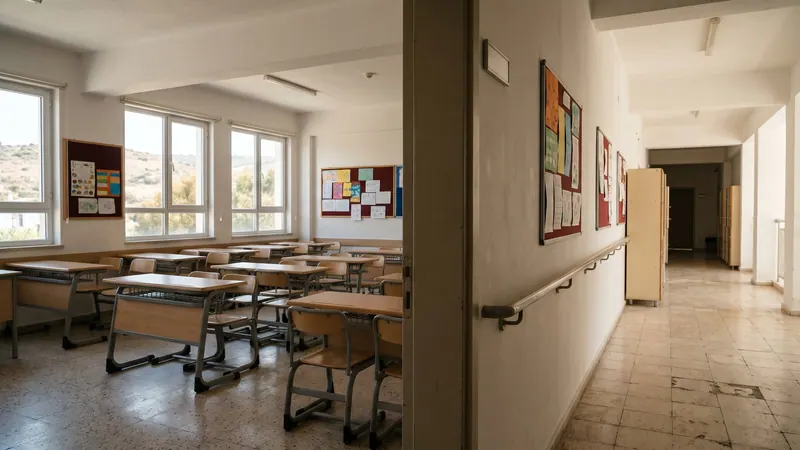
A school building is full from morning to evening and completely empty in the holidays. For pests those two extremes make an interesting picture: in busy periods the dining hall, tuck shop and bins draw them in; in empty periods, classroom corners and storerooms nobody visits become quiet shelters.
Bodrum’s summer break is long, so getting a school building ready for the new school year is an important time. Activity around the garden, sports field and dining hall picks up again at opening. We make no comment on health or education rules here; the page only explains how a school or nursery can keep a tidy, pest-free setting.
Pests that visit schools
- ants, around the tuck shop, school bags and garden edges
- cockroaches, usually near the dining hall, toilets and drains
- flies, at bins, in the garden and at open windows
- wasps and bees, on garden flowers and in open eating spaces
- mice, which may leave signs in the store, boiler room and behind the kitchen
- spiders, building webs in classrooms and archives left unused for long
The parts of the building
In a school, trouble most often comes from:
- the dining hall, tuck shop and kitchen store
- classroom corners, behind cupboards and the library
- the toilets and the area around basins
- the garden, play area and sports-field edge
- the rubbish collection point
- the boiler room, archive and equipment stores
These sections are used by different people at different times, so when and where work happens should be agreed with management. For how the process goes in another crowded building, read about hospital pest control; for schools with large grounds, garden pest control is helpful too.
What school management can prepare
To speed up the inspection, management can have to hand:
- a list showing where pests were seen and roughly when
- the building’s timetable: lessons, holidays, events
- how the dining hall and tuck shop are run
- notes on earlier treatments, if there are any
This helps arrange the work so it gets in the way of the building as little as possible.
Getting ready for the new term
In schools closed over the summer, classrooms, cupboards and the dining hall go unused for a long time. Reviewing these sections before opening lets you see any problem before pupils arrive. It is also useful to add the garden layout, the bin area and the tuck-shop store to the list before term starts.
In nurseries and kindergartens, play areas and nap rooms should be thought about separately in the planning.
Areas used by children
The question most often discussed in schools and nurseries is how the area can be used after treatment. We tell school management what to watch for after the work.
Gardens and play areas used by children are parts that need separate thought, so it helps if management notes beforehand what it wants to draw our attention to.
Another practical step is to gather the observations of teachers and cleaning staff in a single list. An ant trail seen by a class teacher, a cluster of flies noticed by the tuck-shop worker or a rodent sign found in the basement by the caretaker may look small alone but together draw a very valuable map for the inspection.
How the visit goes
When school management gets in touch, we first carry out a free inspection. We walk the dining hall, tuck shop, toilets, garden and stores, and establish the pest, its numbers and where it nests on site. We choose the method for the area, with Ministry of Health approved products and a certified team. Afterwards we tell management what to watch for and, if needed, make a check visit. For a same-day appointment, ring us.
For methods, see pest extermination in Bodrum and insect control in Bodrum; the other sectors are on the services page.
Where we work
We serve schools and nurseries in Bodrum town, Yalıkavak, Bitez, Turgutreis, Ortakent and the surrounding areas.
Appointments
To plan a free inspection for your school or nursery, contact us by phone or WhatsApp. If children report a trail across the classroom floor, our types of ants guide helps identify it.