
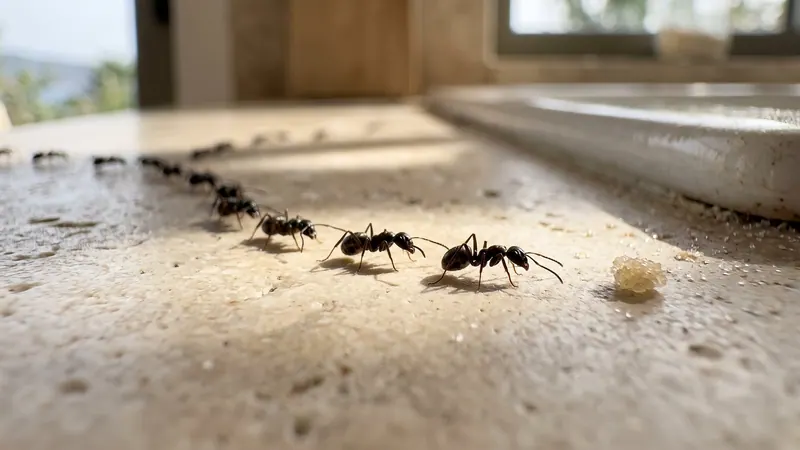
Ants look innocent one at a time. The trouble is that each one belongs to a colony. A thin black line across the worktop, a trail from the garden into the hall, winged insects at the window in spring: each tells a different story. The six questions below help you work out which one you are reading.
Question 1: How big is it?
Very small, up to about 3 mm. These are the little ants that come right inside and head for sweet and greasy foods. They lay down a trail and use the same route again and again, so following the line back often reveals the way in. The University of California’s ant guide lists species of this size, such as pharaoh ants at about 1/16 inch and thief ants at about 1/32 inch.
Medium, 3 to 5 mm. Ants of this size, such as the Argentine ant at about 1/8 inch, nest in gardens, terraces and along paths. Indoors they head for the kitchen, window sill or doorstep. Their nests may be under stones, in cracks in paving or under plant pots.
Large, 6 mm and more. Big black or reddish ants are often carpenter ants. The guide gives workers at one quarter to one half inch, black or red and black. They do not eat wood but hollow it out to nest, and they can cause considerable damage.
Question 2: What are they eating?
What the trail is heading for is a clue.
- Ants at syrup, honey and fruit juice are usually sweet-seekers.
- Ants at greasy scraps and meat residue gather around bins and plates.
- Ants tending aphids in the garden often move from plants into the house.
There is no strict rule, and diets change with the season, but watching what the trail reaches supports your guess.
Question 3: Are there winged ones?
In spring and early summer, winged ants leave the nest in numbers. They fly to found new colonies and most disperse quickly. Telling them from winged termites matters. The University of California guide says that an ant’s body is constricted, giving it the appearance of a thin waist, while a termite has a broad waist. The ant’s hind wings are smaller than its front wings, and ants have elbowed antennae. A close photo of the insect, perhaps caught on a piece of clear tape, makes these features much easier to see.
Question 4: Is there wood nearby?
Fine shavings below roof beams, window frames or damp furniture suggest carpenter ants, and an entrance to the nest is often above the debris. Here the root cause is usually moisture: a leak, an overflowing gutter or a damp, closed-in space. For other wood-related pests see our page on woodworm treatment.
Question 5: Where does the trail come from?
Following the line back is worth more than guessing the species. A trail entering at the base of a wall points to a crack in the outer wall, one at a window edge to a neighbouring plant, and one emerging from a drain to a damp area. Walk the line as soon as you can and mark where it enters.
Question 6: When do you see them?
Trails that grow busy in the early morning and late afternoon usually mean foraging. A line that carries on all day and into the night can mean the nest is close. Watch on a few different days at different times and keep notes, so that you see the true scale of the problem.
Summary table
| Appearance | Likely group | Clue |
|---|---|---|
| Very small, pale | Small household ants | Trails round sweet items in the kitchen |
| Medium, dark | Garden ants | Door threshold, sill, plant pot base |
| Large, black or reddish | Carpenter ants | Shavings and damp near timber |
| Winged individuals | Reproductive stage | Mass emergence in spring and early summer |
Treat the table as a starting point. A real identification needs a magnified photo or a sample.
Why do they come indoors?
The University of California guide states that ants often enter buildings seeking food and water, warmth and shelter. They may also come in to escape dry, hot weather or flooding, and can appear suddenly if other food sources become unavailable or the weather changes. Understanding this helps you address the cause instead of chasing individuals.
Where might the nest be?
A trail entering the house usually leads to a nest outside. Common spots are under stones and paving, beneath plant pots, in cracks at the base of walls, along lawn edges and in rotten timber. Inside, think of the space behind a bathroom radiator, beneath the kitchen worktop and damp wall cavities. Putting out a tiny drop of honey away from the trail and watching which way the line turns can give you an idea of the nest’s direction.
Three rules that help with every type
- Close up the food. Keep sugar, honey, jam and pet food in sealed containers.
- Close up the entrances. Find the cracks around sills, thresholds and pipe holes. The University of California guide advises caulking cracks and openings that give entry into buildings.
- Wipe the trail. Ants leave a scent trail, so wiping the line with soapy water makes it harder for newcomers to follow.
The same guide recommends removing food and water, which means storing food in sealed containers, cleaning up crumbs, grease and spills, and fixing leaky taps. It also says that spraying ants indoors will not prevent more ants from entering and that sprays only provide temporary control.
Holiday homes in Bodrum
A hot, long summer keeps ants active for months. Irrigated gardens, pool surrounds and shaded terraces suit nests, and a kitchen shut up for weeks is a familiar complaint at the start of the season. If you are preparing a house for the winter, the holiday home closing checklist lists what to clear out first.
A kitchen check when ants appear
- Are there crumbs, drips of juice or an open jar on the worktop?
- Is the bin lidded, and is it emptied often enough?
- Is a ring of ants forming around pet food?
- Is there a crack in the sealant at the window or the skirting board?
If you answer yes to most of these, the real issue is that the kitchen is attractive to ants. For more habits that help, see our kitchen pest prevention routine.
Mistakes people make
- Wiping only the ants you can see. While the entrance remains open, new workers keep using it.
- Protecting food only in the fridge. Sugar, honey and jam in cupboards are targets too.
- Leaving pet bowls on the floor. The area around a bowl is an easy meal. Lift it at night.
- Ignoring a nest near the door. If the nest is close, the indoor trail will keep returning.
- Overlooking damp. Leaking taps, water in plant saucers and overflowing gutters invite ants and other insects.
When the trail returns every year
If ants return from the same place each year, you see shavings in timber, or trails reach several rooms, the nest may be inside the house or in a wall cavity. Our page on ant control explains our approach, and you are welcome to contact us through the contact page for a free inspection.
A small observation experiment
To find out what ants prefer, put out three small portions in the evening: something sweet, something greasy or protein-rich, and something plain. Half an hour later, see which they choose. This shows what they want and where the trail leads. Do it for observation only, then remove the plates and wipe the area.