
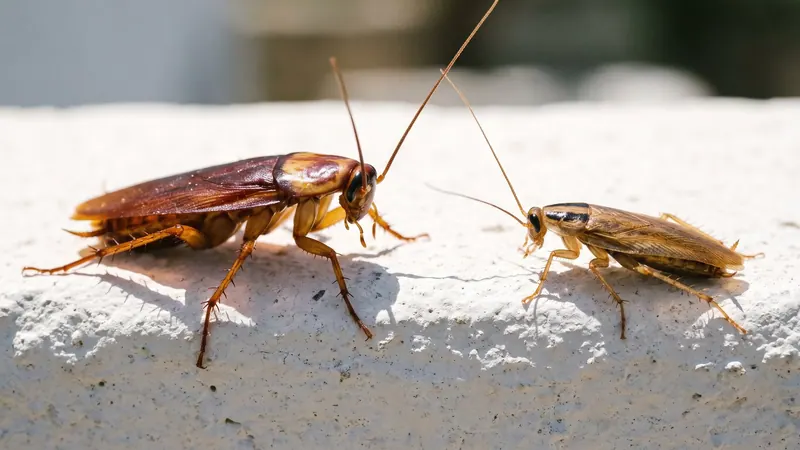
You switch on the kitchen light at night and a brown shadow races for cover. Your first question is “what is that?” and your second is “is it one or many?” Both depend on the species. Of the thousands of cockroach species in the world, only a handful live in homes, and telling them apart is easier than it sounds.
Three things to note first
No laboratory is needed. Three observations do most of the work:
- Size. Is it about the size of your fingernail, or as long as the top joint of your thumb?
- Colour and pattern. Does it have stripes behind its head, pale bands on its wings, or a glossy near-black body?
- Place. Where do you see it most: on the worktop, around a drain, in a basement or on top of a wardrobe?
Put the three answers together and the species is usually clear. The University of California’s cockroach guide describes four common household species, and the descriptions below follow it.
German cockroach
This is the species most often found in kitchens. Adults are about half an inch (around 1.3 cm) long and light brown, with two dark stripes on the shield-like plate behind the head. German cockroaches favour kitchens, food preparation areas and bathrooms, where warm, humid conditions meet food and hiding places. The female carries a light beige egg case, about a quarter of an inch long, until shortly before it hatches, so one egg-carrying female can mean the problem is growing.
With this species, location is the clue. The likeliest hiding places are under the sink, around a fridge motor, behind the cooker and in the joins of drawers. For the full list of signs, see our page on cockroach control.
Brownbanded cockroach
Similar in size to the German cockroach but marked differently: instead of stripes behind the head it has light bands across the wings and body. Males are golden tan and females darker brown. This species often hides in crevices in or near electrical appliances and is not usually associated with food preparation areas, so a small cockroach in a bedroom or living room rather than the kitchen should make you think of it. The females glue their egg cases to ceilings, beneath furniture and in other dark places, and only the adult males fly.
American cockroach
The largest of the four, at about two inches (around 5 cm), reddish brown with light edges to the plate behind the head. It prefers warm, humid conditions and is common in sewers, water meter boxes and storm drains. A few cockroach species can fly short distances or glide on warm nights as adults.
This species is linked to the outdoors, so the question is not why it is in your kitchen but how it got in. Drain covers, door gaps and warm plant rooms are likely routes.
Oriental cockroach
Almost black and about an inch and a quarter (about 3 cm) long. Males have wings shorter than the body and females have wings that are not fully formed, so this species does not fly. It likes cool, damp, dark places such as garages, basements, water meter boxes and drains, and it cannot climb smooth vertical surfaces. One that tumbles into a bath or basin can therefore be stuck there.
Side by side
| Species | Size | Distinguishing feature | Where you meet it |
|---|---|---|---|
| German | Small | Two dark stripes behind the head | Kitchen, bathroom, behind appliances |
| Brownbanded | Small | Pale bands on wings and body | Appliances, furniture, drier rooms |
| American | Large | Light edge on the plate behind the head | Drains, sewers, warm cellars |
| Oriental | Medium | Almost black and glossy | Cool ground floors, basements |
Taking a useful photo
A coin beside the insect shows its size. Take one picture from above and one from the side if you can, and note exactly where you found it, because half of identification is location. If you manage to catch it, a closed jar is the best specimen for a visit.
What identifying the species changes
With small species the focus is usually food and crevices: crumbs, unwashed dishes and gaps around appliances. With large species entry routes and damp matter more: drain covers, gaps under doors, cellar and sewer connections. Searching in the wrong place gets you nowhere. The UC guide lists the same basics for all species: store food in sealed containers, fix leaks and moisture, limit hiding places and routes into living areas, and seal cracks and openings to the outside, using door sweeps and weather stripping.
What does seeing one mean?
Cockroaches hide by day, so seeing one in daylight sometimes points to a population that is already established. To check, look at night and use sticky traps for a few days. Place them along walls, under sinks and behind appliances, then compare the catch by location. That tells you both the species and the scale of the problem. Our kitchen pest prevention routine describes how to do a night check step by step.
What does an egg case look like?
German and brownbanded females carry or deposit a small brown, bean-shaped capsule. You may find one in a drawer corner, between boxes or behind an appliance. Treat it as a sign of a breeding group rather than a lone insect. Crushing or sweeping up a single case is not enough, because there may be others nearby and hidden adults.
When you cannot tell
A blurred photo, a fleeing insect or a squashed fragment is very common. You do not have to decide. Write down where and when you saw it, the approximate size and the colour. Catch an adult in a lidded jar if you can. A second sighting a few days later usually clears up the doubt, and tidying food and damp helps with every species in the meantime.
What a dead cockroach tells you
A single large dead cockroach on its back is often a lone visitor from outside. Many small dead ones of different sizes in one place suggest a settled group, because young and adults live together.
Climate and the seasons
Warm, humid summers make cockroaches more active, and heated buildings let them carry on through the winter. In seasonal businesses and holiday homes that stand empty, long closures can bring a surprise when you reopen. Our guide to a holiday villa pest check on reopening shows how to look for them. For hotels and guesthouses, the guesthouse pest control checklist turns this into a routine.
What helps whichever species you have
- Keep food in closed containers and do not leave dishes overnight.
- Use a lidded bin and empty it regularly.
- Fix dripping taps and damp corners.
- Cut down cardboard boxes, piles of newspaper and packaging.
- Close the gaps under doors and around pipes.
These measures reduce the problem, but cockroaches can hide inside walls and appliances, so cleaning alone is not always enough. Neighbours matter too: in apartment blocks, insects can move between flats.
Where to go next
Once you know which species you are dealing with, the most useful follow-up is usually the kitchen: start with the evening and weekly routines in our kitchen pest prevention routine. If you run a business, the same ideas are laid out room by room in the guesthouse pest control checklist.