
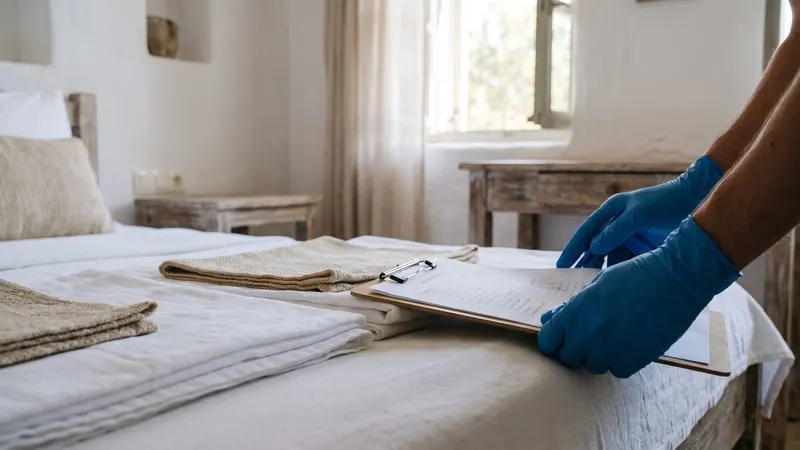
In a guesthouse with a handful of rooms the manager is also the receptionist, the breakfast cook and quite often the cleaner. There is no room for a separate pest team, but a short, regular routine is possible. The checklist below is split into daily, weekly and seasonal tasks, with a section on the kitchen and one on the outdoor areas. It is general guidance for owners. It is not a substitute for a professional inspection when you suspect a problem.
Daily: a ten-minute round
Either before cleaning starts in the morning or before you close in the evening:
- Look over the breakfast room and kitchen for crumbs on the worktop, open food and spilled liquid.
- Keep bin lids closed and empty the bins at the end of each shift.
- Check the screen and door at the bin exit.
- Record any dead or live insects you see in reception or corridors.
- In bathrooms look at drains and damp corners.
Tick these on a printed checklist. That way responsibility is clear and a gap becomes visible.
Weekly: rooms and shared areas
Once a week, in empty rooms, look at the places daily cleaning misses:
- Beds and bases. Mattress seams, base edges, the headboard and the gap between it and the wall.
- Behind furniture. The space between bedside tables, wardrobes and the wall.
- Curtains and rails. Small, pale insects or eggs.
- Sockets and electrical equipment. Heat-loving species such as cockroaches like these.
- Balcony and terrace. Standing water, dead insects and webs.
Small blood spots near the bed, dark specks or shed-skin-like debris may suggest bed bugs. The CDC’s bed bug page lists signs to look for as shed exoskeletons, bugs in the folds of mattresses and sheets, rusty-coloured blood spots on mattresses or nearby furniture, and a sweet musty odour. It also says bed bugs are not known to spread diseases but can cause itching and sleeplessness, and that early detection can make infestations easier to control. For a closer description, read our page on bed bug treatment.
Kitchen and breakfast room: its own section
The kitchen is the guesthouse’s pest hot spot, and the people working there can use these questions:
- Are dry-food containers closed?
- Are the back of the fridge, the area round the cooker and drawer joints cleaned regularly?
- Are vegetable and fruit crates lifted off the floor?
- Is the area round the drain cleaned daily with soapy water and a brush?
If you suspect cockroaches, a look in the kitchen after dark is a useful method, and our guide to cockroach species explains what you may find and where each kind hides. For the routines behind a tidy kitchen, see the kitchen pest prevention routine.
Laundry and storage
Keeping clean and dirty linen apart matters for hygiene and for pests. Do not leave dirty linen on the floor. Use a lidded basket. Store clean linen in plastic covers or a closed cupboard. In store rooms, reduce piles of packaging and cardboard and leave a gap you can clean between the wall and the shelves.
Garden, pool and outdoor areas
Most guesthouses in Bodrum have a garden, a terrace or a small pool. In these areas:
- Check for standing water in plant saucers, gutters and irrigation leaks.
- Keep the bin store away from the building and closed.
- Repair screens and mesh at the start of the season.
- Look for ant trails or nests along walls and at tree bases.
The big pre-season walk-through
Before you open the doors, typically in April or May:
- Walk through every room, the store and the boiler room, looking for signs of rodents, dead insects and webs.
- Close gaps under doors and around vents.
- Air and check mattresses and pillows.
- Brief the staff: what to look for and who to tell.
- Prepare the form you will use to record any problem during the season.
When you reopen after the winter, our guide to opening a holiday villa describes a first-hour, first-night and first-week routine that adapts well to a small guesthouse. For the wider range of insects we deal with in hospitality settings, see our page on insect control.
The one-minute check before arrival
Just before guests arrive, look at five spots in the room: the gap between headboard and wall, the stitching at the edge of the mattress, the area round the bathroom drain, the bottom of the balcony door and the sockets. At each one, look for live insects, dead insects, dark specks or shed skins. It takes under a minute and means you see what the guest would see first.
A short briefing for staff
Staff are the first pair of eyes. A short meeting should cover:
- Which insects to report at once, such as cockroaches, signs of bed bugs or rodent droppings.
- Who to tell and how.
- What to do with linen from a suspect room: seal it in a bag and wash it separately.
- Habits to avoid in the food area, such as leaving lids off or letting leftovers stand.
Repeat the briefing at the start of each season because seasonal staff change.
What a record sheet needs
A record sheet does not have to be complicated. Columns for date, area, what was seen, who noticed, what was done and the result are enough. When you look back months later and one area keeps appearing, the root cause is probably there. The sheet also makes it easier to explain history to a professional if you decide to ask for help.
When a guest complains
- Listen, apologise and do not play the problem down.
- Take photographs and notes.
- Move the guest to another room if needed.
- Record the date, the room number and what was seen.
- Keep the room out of use until you have found the source.
This limits the harm to both guest and business. If the complaint is about bites, remember the CDC’s point that marks may take as long as 14 days to develop in some people, so the source may not be your property at all. Our article on bed bugs and luggage after travel explains how the insects travel with guests, and a guest handout based on it can help.
A sample weekly timetable
| Day | Focus | What to check |
|---|---|---|
| Monday | Empty rooms | Bed, base, curtains, sockets |
| Wednesday | Kitchen and store | Dry-food containers, behind appliances, drain |
| Friday | Outdoor areas | Bin store, garden, irrigation, gutters |
| Sunday | Laundry and common areas | Baskets, cupboards, corridor, reception |
Pin the timetable up in the kitchen so the routine belongs to the system, not a person, and carries on when someone is away. A small torch and the habit of photographing signs on a phone make the records much clearer.
Mistakes small businesses make
- Trying to deal quietly with a problem and losing time.
- Keeping no record and living through the same problem again.
- Being forced to treat in mid-season because the pre-season check was skipped.
- Leaving tasks unassigned.
A timetable and regular checks prevent most of these.
Extra care in peak season
When rooms are turned around quickly there is less time to look. Ask the cleaning team to check the bed edges and base seams, and to do a five-minute pass for insects in each room after check-out. That helps you catch a bed bug problem early.
A short meeting mid-season
In the busy months a fifteen-minute meeting once a month is enough. Keep the agenda simple: what was seen, in which rooms, at what times, which round was missed and whether the record sheet is filled in. Even one task coming out of it can prevent next month’s complaint. Write each task with a name and a date, because “everyone” is rarely anyone.
When to ask for help
Signs that recur in one room, appear in several rooms, or follow a guest complaint whose source you cannot find are worth an on-site assessment, which saves time. If you would like a free inspection, the contact page is the place to ask.