
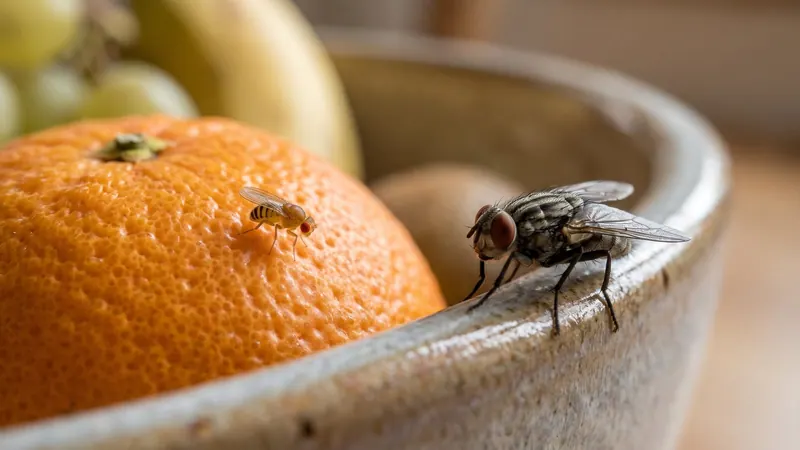
“Fly” covers a lot of ground. The sturdy grey insect that thuds against the glass and the pinprick cloud above the bananas share a name and little else. They arrive for different reasons, breed in different places and are stopped by different habits. Identifying which one you have is therefore the quickest route to getting rid of it.
Begin with the room
Before looking at wings or legs, ask where you see them.
- Around the fruit bowl, wine glasses and recycling: most likely fruit flies.
- Near the door, on the terrace table, by the bins outside: most likely house flies.
- Hovering low over the bathroom or kitchen sink: probably drain flies.
- In the pantry, circling a packet of flour: not flies at all, but moths or beetles.
This is a rule of thumb rather than a rule, but it points you in the right direction in seconds.
The house fly: a visitor from outdoors
The University of California’s house fly guide gives the adult length as less than 3/8 inch, which is under about 9 mm, and notes four dark stripes down the back of the thorax. Eggs are laid in warm, moist organic material such as manure, rubbish, lawn clippings and decaying fruit and vegetables. A female lays several batches of about 100 to 150 eggs, and in ideal summer conditions development from egg to adult can take as little as seven days.
The same page makes a point that changes how you tackle it: flies found inside a building have entered from outside in almost all cases. So the best investment is at the door. It advises sealing cracks around windows and doors, fitting well-made screens, and putting waste in bags inside containers with tight-fitting lids, emptied at least once a week.
On a Bodrum terrace this means keeping the bin away from the dining area, not leaving the kitchen door wedged open in the evening and taking out the bags in the morning rather than leaving them overnight.
The fruit fly: small, slow and attracted to ferment
Fruit flies are only a few millimetres long, usually tan or yellowish-brown, and often have red eyes. They drift rather than dart. What draws them is fermentation: overripe fruit, a splash of wine at the bottom of a glass, beer bottles in the recycling, sweet drinks in cans.
Since the eggs ride in on produce, a clean kitchen can get fruit flies. A good routine is simple:
- Keep ripe fruit in the fridge or under a cover.
- Rinse bottles and cans before they go into the recycling bin.
- Wipe sticky patches on worktops and around the tap.
- Empty the kitchen bin before it reaches the point of smell.
- Dry cloths and sponges instead of leaving them damp.
The drain fly: the third suspect
The small, hairy, moth-like flies that hop around a bathroom or kitchen sink are neither of the above. The University of California’s page on moth or drain flies describes them as about 1/8 inch (roughly 3 mm) long and often dark, with hair-covered wings held roof-like over the body. They are weak fliers that move in short hops. They breed in the organic film that builds up inside drains, and in homes bathroom drains are the commonest site.
The page says that boiling water and bleach do not remove that film and give at best short-term control. What works is scraping and brushing the drain walls, clearing the trap under the sink and then running water to confirm it flows freely. If the flies vanish after this, you have your answer.
Quick comparison
| House fly | Fruit fly | Drain fly | |
|---|---|---|---|
| Size | Up to about 9 mm | A few millimetres | About 3 mm |
| Look | Grey, striped back | Tan, often red-eyed | Dark, hairy, moth-like |
| Flight | Fast, noisy | Slow, drifting | Short hops |
| Draw | Rubbish, animal waste, open food | Ripe fruit, drinks, residues | Slime in drains |
| Entry | Outdoors | Shopping and ripe fruit | Already in the plumbing |
| First fix | Doors, screens, bins | Fruit, bottles, bins | Brush the drain |
Traps: use them to measure
A strip of fly paper or a small saucer of cider vinegar with a drop of washing-up liquid will tell you whether numbers are going up or down. Do not hang sticky strips over food or work surfaces. Think of a trap as a thermometer, not medicine: the cure is removing whatever is feeding the flies.
Seasonal pressure in Bodrum
Long hot summers speed up everything. Open-air dining, bottle collection points and bins that fill after a busy weekend can double the fly count in days. If you run a café, guesthouse or restaurant, bin-area washing and lid checks belong on the closing list. Our kitchen pest prevention routine sets out the evening and weekly jobs, and the guesthouse checklist shows how to turn them into a record sheet.
Keep house flies on the other side of the door
The least laborious measure is also the most effective: narrow the entrance. Close the door behind you, install a fly screen, seal the gaps under the threshold and wash the bin area regularly. For a business, use a separate door for deliveries and waste so flies are not carried through the food area. At home, taking the rubbish out in the morning instead of at night means fewer doors left open after dark.
A five-day plan if you have fruit flies
- Day one: clear the worktops, put the fruit away, empty and wash the bin.
- Days two and three: clean the plughole with a brush and rinse the recycling.
- Days four and five: check screens and window seals.
- Afterwards: a weekly look takes five minutes, and a fresh wave can be traced quickly.
Photographs help
If you cannot tell which fly you have, take a close photo with a coin next to it for scale, and note the time and place. A fly that is large and stripy in a sunny doorway is a house fly; tiny and tan over the fruit is a fruit fly. Add notes on what is nearby, whether that is food waste, bins or a drain, and you are most of the way to finding the breeding site.
If you have done all this and the flies persist, a hidden source such as a damp, rotting deposit inside a wall or beneath a floor may be responsible. Our fly page explains the service we offer for cases like that.