As summer ends, the number of yellow-and-black insects circling a fruit plate on the balcony seems to climb. Are they all the same? For most people everything with stripes is a bee, but honey bees and the wasps that cause most summer trouble differ in looks, behaviour and risk. The difference changes what you should do first. Everything below rests on observations made from a safe distance.
Safety first: keep your distance
Set one rule before you start observing: if there is a nest or a busy flight path, stay several metres back. A phone camera with zoom gives you the detail you need without going near. Keep children and pets away from the area and keep doors and windows closed. Hitting a nest, throwing things at it or squirting it with water can turn a calm colony into a defensive one.
Body: shiny or hairy?
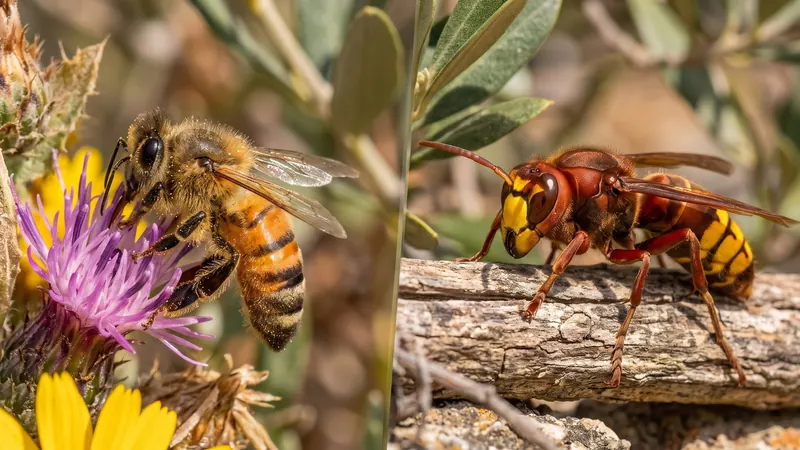
The University of California’s guide to yellowjackets and other social wasps describes these wasps as one half to one inch long with jagged bright yellow and black stripes and narrow waists that are barely visible. Honey bees are less brightly striped and have more hair. Paper wasps are different again, with long slender waists and long legs. When you zoom in, a fine coat of hair suggests a honey bee.
| Feature | Common wasp | Honey bee |
|---|---|---|
| Colour | Bright yellow and black, jagged stripes | Duller, more brownish |
| Body | Smooth-looking, barely visible waist | Hairy, more robust |
| Interest in food and bins | High, especially late summer | Low, mostly flowers |
| Temper | Defends its nest fiercely | Usually stings only when squeezed or threatened |
Here “wasp” means common social wasps and paper wasps. Hornets are also wasps, and the same rule of keeping your distance applies.
Behaviour: what are they after?
The most useful clue is what the insect has come for. According to the same guide, by late summer colonies grow more slowly or stop growing and foraging wasps become particularly interested in sweet things. In autumn these wasps start to show up at picnics and barbecues and around rubbish bins. A striped insect landing on your plate, your drink or the bin is therefore more likely a wasp. A honey bee mostly works flowers for nectar and pollen.
The difference shapes the precaution. To cut down on visitors, do not leave sweet food, juice glasses or pet food outside. The guide recommends keeping food, including pet food, covered or indoors, covering drink cans so wasps cannot crawl in, and keeping rubbish in sealed bins that are emptied regularly. Our kitchen pest prevention routine covers bins and food storage in more detail.
Nests: where and what shape?
Nest site is often the most telling clue, but not conclusive alone.
- Common wasps: nest in holes in the ground, inside wall cavities or in hanging nests.
- Paper wasps: hang open-celled paper nests in protected places such as under eaves, in attics or under tree branches or vines.
- Honey bees: often nest inside cavities in trees or houses.
Because common wasps can use wall cavities too, judge the nest site together with the body and behaviour of the insects, not on its own.
In a holiday home that has stood empty, a nest can grow unseen for months, so look at the eaves, shutters and roof edge when you reopen. Our guide to opening a holiday villa includes a walk around the outside of the house.
Stings and the first response
A honey bee generally stings when it is squeezed or crushed. Wasps defend their nests hard and may also sting when disturbed while feeding. Staying calm matters. The guide advises that if a wasp lands on you, you should not swat it or run, but wait for it to leave or gently brush it away.
After a sting, keep the care simple: wash the area with clean water and watch the person. If there is difficulty breathing, swelling of the face or lips, or dizziness, call emergency services (112 in Turkey) without delay. If milder symptoms persist or are severe, go to a health facility. If you know you are allergic, follow the plan agreed with your own doctor. We do not recommend medicines or doses here.
Why honey bees deserve care
Honey bees pollinate and are usually not a danger. If a colony has settled in a wall or roof space, treating it like a wasp nest is unnecessary and harmful. Contact a local beekeeper or the relevant authority first, because relocating the colony may be possible. If you are unsure of the species, do not touch it; a photograph taken from a distance is the safest way to get advice.
Likewise, do not disturb bees working lavender or thyme in the garden. Their behaviour is calm and flower-centred, and leaving them alone protects pollination too.
Quick rules for children and pets
Children are the most easily caught out, because they do not know where a nest is. Teach one rule: if something flying comes close, do not run or shout, but walk slowly away. Pets can meet wasps at a dropped piece of fruit or a food bowl, so bring bowls in at the times when insects are busy and keep animals away from any nest. If a pet swells up or seems weak after a sting, call a vet.
Early signs of a nest
A nest often shows itself through behaviour before it is seen. Insects flying in a straight line to one spot and disappearing, traffic in and out of a wall crack or a hole in the ground, an unusual number of wasps in one area late in summer, and a faint hum from inside a wall can all suggest a nest. When you notice such signs, watch briefly from a distance instead of standing near the hole. Standing in front of an entrance raises the chance of stings for you and anyone nearby. Add the time of day to your notes, because the busiest hour helps whoever assesses it.
Five questions to answer
For any wasp or bee problem, these answers help you and anyone you call:
- Are the insects at food or at flowers?
- Are their bodies smooth and bright, or hairy?
- Is a nest visible, and where (ground, eaves, wall cavity, tree)?
- How many insects come and go, and is the number rising?
- How close is the nest to a seating area, a door or a children’s play space?
Write the answers down and, if you can, add a photo taken from far away.
Why more at the end of summer?
Common wasp colonies grow through the summer, and the number of workers peaks near the end. People are outdoors eating at the same time, so contact increases. It is no surprise that complaints rise in August and September. Plan accordingly: leave no open food out, keep bin lids closed and pick up fallen fruit.
What not to do yourself
Burning a nest, flooding it or spraying it is dangerous and often makes it angrier. Instead, mark where the nest is and keep people and animals away, pause work in that area for now and show a photo to a professional. The same principle applies to other wild creatures you do not know well: keep your distance and do not try to handle them. For spiders, which people often fear more than they need to, see our guide to types of spiders in the house.
Summary
Bright, smooth-bodied insects that go for food, with a nest in the ground or under the eaves, suggest wasps. Hairy insects that work flowers, with wax combs in an enclosed cavity, suggest honey bees. If you cannot decide, stay away from the nest. Our page on wasp and bee control explains how nests are handled.