
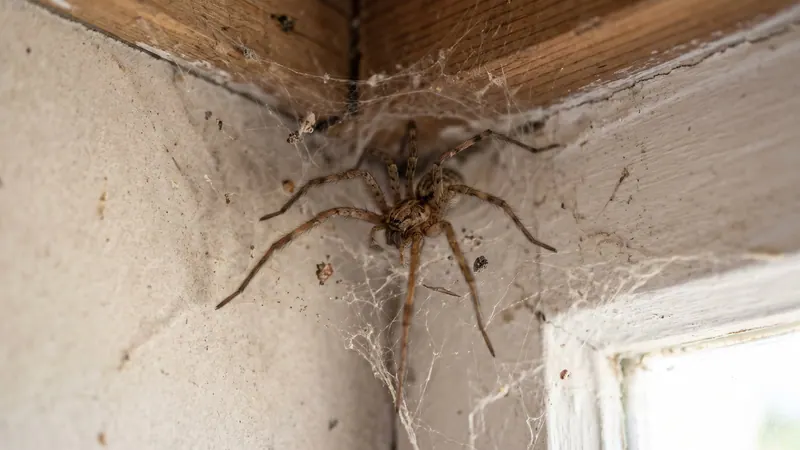
Fear of spiders is very common, but it rarely matches the real risk. The jaws of most household spiders are too small to bite a person, and their venom is not a serious danger. Even so, it helps to recognise the main groups and to know when to take care. The guide below sorts the spiders you meet indoors and around the house by the shape of their webs.
Read the web
You can learn something even if you never see the spider.
Tangled, dusty corner webs. Untidy, dense webs in ceiling corners, along window frames and behind furniture usually belong to house spiders. The University of California’s spider guide says that the common house spider makes a cobweb in corners of rooms, in windows and in similar places, and describes cobweb weavers as building irregularly spun, sticky webs. Sweeping them away is enough.
Webs of very long-legged spiders. In cellars, store rooms and ceiling corners you may see spiders with remarkably long, thin legs hanging in loose webs. The same guide says that the marbled cellar spider mainly causes problems by producing messy cobwebs and is only marginally capable of biting humans.
Single round webs. Neat wheel-shaped webs on a balcony, a garden or an outside wall corner belong to orb weavers, whose webs the guide describes as elaborate silken webs spun in concentric circles. They catch flying insects and are of little concern.
Spiders that do not build webs. A big, fast spider running across a floor is often a hunting spider such as a wolf spider. The guide explains that many large hunting spiders found indoors are fully grown males that have matured and are searching for females. They hunt instead of waiting in a web, and they sometimes wander in by accident.
Five groups worth recognising
- House spiders. Small, brownish, with untidy webs in corners. Often numerous.
- Long-legged cellar spiders. Very thin legs, hanging from a loose web in ceilings and cellars.
- Hunting spiders. Large, fast and usually dark, found running on the ground. They come from outside.
- Sac spiders. The guide mentions spiders that spin silken tubes or sacs, which may turn up in folds of fabric or corners of walls.
- A few species that can cause real trouble. There are some spiders around the world whose bite is a real problem. If you cannot identify one, do not touch it.
The guide stresses that most spiders are beneficial because they feed on pest insects, and that control rests on simple measures. Its examples are specific to California, so for local species you need advice from someone who knows them.
Season and setting in Bodrum
As the weather cools in late summer and autumn, spiders outside may look for shelter in buildings. Garden villas, stone houses and homes that stand empty are especially likely to have webs in wardrobes, behind curtains and in ceiling corners when you reopen them. That is usually a natural settling during the closed months, not an infestation. If the numbers are very high or webs keep returning, there may be a lot of insects underneath, which is worth tracing. Our guide to opening a holiday villa includes a room-by-room look that catches this early.
Easily confused creatures
Some creatures look like spiders but belong to other groups. Ticks have eight legs and are relatives of spiders, but they are blood-feeding parasites. Centipedes and millipedes are many-legged creatures of a different kind, and our article on centipedes and millipedes explains how to tell them apart.
Live with them or move them?
For most people the sensible approach is to carry the spider outside and close the entry points. Catching it under a glass with a piece of card and releasing it in the garden protects both of you. Clearing webs and sweeping corners regularly makes it harder for a spider to settle again. The guide notes that vacuuming up the spider and its web is effective because soft bodies usually do not survive, and says insecticides will not provide long-term control and should not generally be used against spiders outdoors. If you think a product is truly needed, discuss it with a professional first and follow the label.
A suspected spider bite: no panic
Many marks blamed on spiders are actually caused by other things, such as insect bites, skin infections or allergies. If you believe you were bitten:
- Wash the area with clean water.
- Photograph the spider, or capture it safely, if you can.
- If there is severe pain, spreading redness, fever, dizziness or breathing difficulty, or if symptoms persist, go to a health facility.
This page is not medical advice. For your own health, ask a doctor.
Why are there spiders at all?
Spiders live where there is food. If you keep seeing them, there are usually other small insects for them to eat, such as flies, moths, ants or cockroaches. Dealing with spiders alone treats only the visible part of the problem. Cutting down other insects in the house lowers spider numbers indirectly.
Prevention list
- Repair screens on windows and doors.
- Check that pipe entries and gaps under doors are sealed. The guide advises sealing cracks in the foundation and gaps around windows and doors.
- Reduce piles of cardboard and clutter in cellars, stores and garages. The guide says to prevent clutter buildup that can provide hiding places both indoors and out.
- Sweep or vacuum corner webs regularly.
- Keep lighting fixtures off the structure and away from windows and doors if possible. The guide notes that outdoor lighting attracts insects, which in turn attract spiders.
- Shake out shoes, gloves and clothes that have been stored before putting them on.
- When reopening a holiday home, check wardrobes, curtains and the backs of furniture.
A quick way to assess one
Whenever you see a spider, ask in order:
- Where is it? Ceiling corner, floor, inside clothing or outside wall?
- Is there a web? Untidy, a neat circle or none?
- How big is it? Smaller than a fingernail or larger than a coin?
- How does it move? Running fast or sitting still?
- When? In daylight or at night?
These five answers usually identify the group. A very large, hairy spider that has come into the house is often a lost male wolf spider, and the calm response is to put a jar over it and carry it outside.
Which spot, which spider
- Bathroom and cellar: long-legged cellar spiders.
- Kitchen corners: small house spiders.
- Bedroom and wardrobe: only occasionally a sac spider.
- Garden and balcony: orb weavers and wolf spiders.
- Store room and garage: house spiders, occasionally a wolf spider.
Egg sacs and signs of hunting
Spiders lay eggs in a silk sac. A soft white or cream ball in a corner is often just that. The sac itself is harmless, but hundreds of young can emerge from it. Vacuuming it up and tying the bag before throwing it away is enough. Dead flies and other insect remains under a web show that the spider is hunting there and that its food comes from inside the house.
Children and pets
Teach children to watch spiders from a distance and not to pick up unknown creatures, rather than fear them. Pets are sometimes curious enough to chase spiders, which can raise the chance of a bite. For wasps and bees, another group people tend to fear, our article on telling a wasp from a bee gives similar distance-based advice.
Watching without killing
A small spider in the house is usually a neighbour that eats other insects. Look at where it builds and how often it rebuilds. A web that is rebuilt quickly shows there is prey in the area. Sorting out the flies, moths and cockroaches may make the webs disappear by themselves. Wiping webs with a damp cloth and writing down the date also makes it easier to see what is happening.
Reading the signs
If webs keep returning quickly, or you think you have met a species that could be dangerous, have it looked at rather than guessing. Our page on spider control explains how we approach it.