
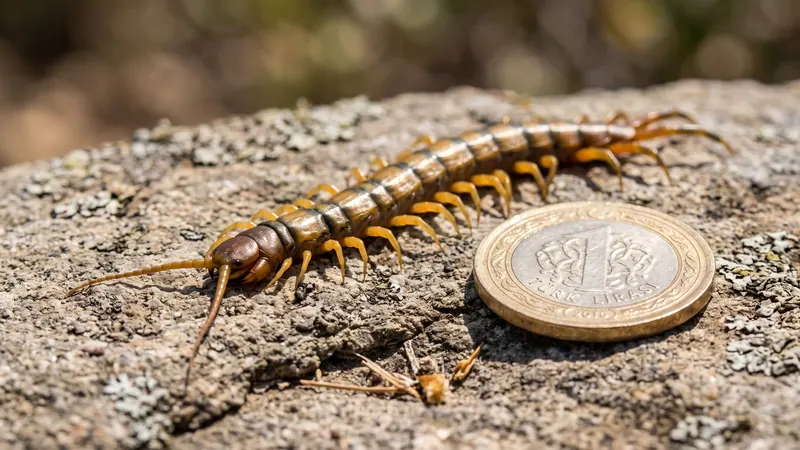
When a long, many-legged creature appears in the bathroom or on the terrace, you first want to know what it is. One of the two possibilities is a fast predator that may bite, and the other is harmless but unpleasant. Common names vary from region to region, so this guide compares features and leaves the names aside.
Look at the legs
If you can see the body clearly, the legs are the most reliable check.
- Centipede: flattened body with one pair of legs on each segment. The University of California’s guide to centipedes and millipedes describes them as elongated, flattened animals.
- Millipede: a rounder, cylindrical body with two pairs of short legs on most segments (sometimes four pairs), tucked under the body.
Counting legs on a live animal is not practical, but the difference shows in behaviour too.
Movement and behaviour
A centipede moves rapidly and hunts other small animals. The house centipede in particular has long legs that let it run fast. A millipede is slow and feeds on moist, decaying plant matter. The guide notes that when prodded or at rest most millipedes curl up, whereas centipedes never coil up when disturbed. A coiled spiral is the quickest sign you have a millipede.
Bite risk
The same guide says that when provoked, some large centipedes can inflict a painful bite that may cause localised swelling, discolouration and numbness, while millipedes do not bite when disturbed. However, some millipede species exude a defensive liquid that can irritate skin or burn the eyes. So do not pick up a centipede with bare hands, and do not squeeze a millipede.
If someone is bitten, wash the area with clean water. If symptoms persist or are severe, go to a health facility. This page is not medical advice.
Side by side
| Centipede | Millipede | |
|---|---|---|
| Body | Flattened | Round or cylindrical |
| Legs | One pair per segment | Two pairs per segment, mostly |
| Speed | Fast | Slow |
| Food | Other small animals | Moist, decaying plant matter |
| Bites? | Can, if provoked | No |
| When disturbed | Runs away | Curls into a spiral |
Why do they come indoors?
Moisture is the common reason. Centipedes are usually found in damp, dark places such as under stones, leaf mulch or logs, and millipedes feed on moist, decaying plant matter. When a garden is full of damp organic material, both settle there. The guide says large millipede migrations occur when living places become either too wet or too dry, and that those that wander inside usually die quickly because of the dry conditions and lack of food. Centipedes may occur indoors in damp areas of basements, cupboards or bathrooms.
A centipede indoors can also mean it has found something to eat. The guide notes that house centipedes capture flies, cockroaches and other small household pests, so seeing one may suggest there are other insects around. For the insects it may be hunting, see our guide to cockroach species.
Day or night?
Centipedes tend to hide by day in a damp spot and come out to hunt, so a long creature at the edge of the bath at night is often a hunting centipede. Millipedes tend to show up in numbers after rain or when it turns very dry. A sudden crowd of millipedes is usually a movement out of a damp patch in the garden, not a sign that they are settling in your home.
Where do they hide?
- Centipedes: bathrooms, store rooms, basements, boiler rooms, behind furniture, around the washing machine.
- Millipedes: door thresholds, ground-floor corners, the base of plant pots, stone and leaf piles at the edge of the garden.
Checking these places regularly turns several surprises a summer into one calm look. If you also have spiders in these spots, our guide to types of spiders in the house can help you separate them.
The long-legged house centipede
A very long, thin-legged creature that races across the bathroom or pantry is often a house centipede. According to the University of California it eats house pests such as flies and cockroaches and does not damage plants or household items. Seeing one therefore tells you that there is probably other insect life in the house, and that is the place to look.
When you meet one: do and don’t
- Do switch on the light, keep your distance, and either trap it under a jar with a stiff piece of card and release it outside or sweep it out with a brush.
- Do look for how it got in, such as a drain opening, gap under a door or basement window, and mark it.
- Don’t pick it up bare-handed or try to stamp on it. A provoked centipede may bite.
- Don’t walk barefoot through the bathroom or basement at night. Slippers and a light are enough.
- Don’t squeeze a millipede. Its defensive fluid can irritate skin and eyes.
Prevention list
- Reduce damp. Repair dripping taps and irrigation pipes. Air out basements and bathrooms. The guide recommends airing out damp places and drying out excessively moist sub-floor crawl spaces or basements.
- Tidy the garden. Move leaf piles, mulch, logs and stone heaps away from the base of the house.
- Seal entries. Look at door gaps, windows, basement openings and pipe penetrations. The guide says sealing cracks and other openings to the outside helps prevent millipedes from entering.
- Check outdoor lights. Lights attract insects, and insects attract the things that eat them.
- Cut down other insects indoors. Cockroaches and silverfish are food for centipedes.
- Shake out shoes and gloves before putting them on, particularly ones that have been stored or used in the garden.
Season and setting in Bodrum
In hot summers, dry soil may push garden creatures towards damp indoor spaces. After autumn rain, basements, store rooms and stone-built houses are most at risk. When you close up a house for winter, check damp and entry points; our holiday home closing checklist covers both.
Monitoring indoors
To see where a centipede gets in, place sticky tape traps near the threshold or bathroom door, out of reach of children and pets. The size and number of what you catch suggest whether the source is the garden or the building. If the number is low and there is one crossing point, closing that point may be enough.
Families with children and pets
Children naturally want to pick up any creature they find. “Do not touch, show us” is the safest rule. Pets may also take an interest, so keep their play area away from damp corners and stone piles.
Three common mistakes
“A centipede coming out of a wall means the building is rotten.” Most centipedes enter from a basement or ground-floor void. The structure is rarely the issue. Moisture and gaps are.
“Millipedes eat wood.” They feed on decaying plant matter, not sound timber. If you see damage in wood, look for another cause.
“This will stop in winter.” In a mild coastal climate these creatures can stay active for much of the year, so do not limit prevention to summer.
Photographing safely
Do not move closer to take a picture of a creature you suspect is a centipede. A ruler, a broom handle or an object next to it shows scale, and the zoom on your phone saves you from approaching. Do not pick it up. Cover it with a jar and write the date and place on a note for later.
Where to look first
If centipedes keep turning up, or large numbers of millipedes gather in a basement or on the ground floor, start with the damp: find the leak, the blocked drain or the wet corner that is drawing them in. Our page on insect control sets out how we deal with household insects when the source is not obvious.