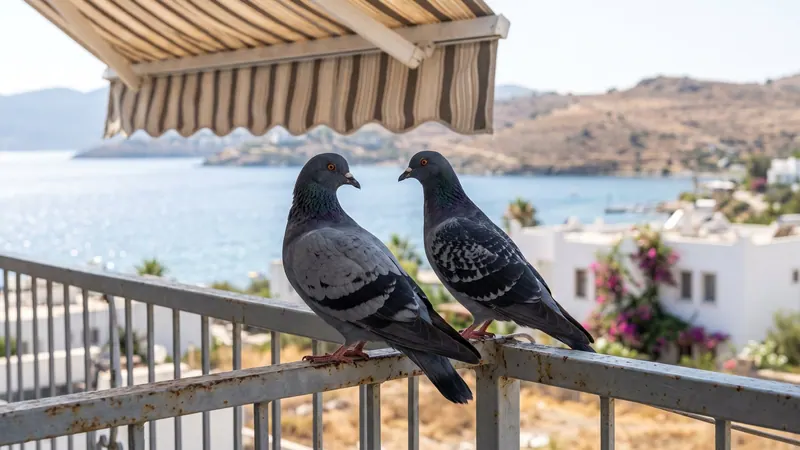
You step on to the balcony one morning and find a smear of droppings on the floor, a feather on the rail and a few twigs behind the plant pot. The pigeon has moved from visiting to house-hunting. Chasing it away rarely helps for long, because a bird that has found a safe spot comes back. The only lasting answer is to make the balcony a poorer place to live in than the one next door.
What makes a balcony attractive
Town pigeons descend from rock doves that nested on cliff ledges, and buildings serve them as artificial cliffs. A balcony can offer three things: shelter from wind and rain, a lookout point and food within reach. The Utah State University rock pigeon note says they nest on flat, covered surfaces such as sheltered ledges, bridges and building surfaces, building crude platforms from twigs, grasses and sticks. That describes a covered balcony corner almost perfectly. The same page says pigeons eat grain and seeds, but also food provided for them, intentionally or not, by people.
Air-conditioning units, the back of large plant pots, a pile of stored items and the dark ceiling corner are particular favourites.
Reading the stages
Look at what you see and decide how far things have gone.
| What you see | What it means | What to do |
|---|---|---|
| A few droppings, one or two feathers | A perch or lookout | Remove the perch, clear food, clean up |
| Twigs, scraps, a flattened spot | Nest building | Remove material daily and put up a barrier now |
| Eggs, chicks, constant cooing | An active nest | Do not rush: seek advice first |
The first two stages are cheap to manage. The third involves welfare and sometimes legal questions.
Discouraging without harm
The aim is not to injure the bird but to make the site unattractive. Methods that work include:
- Physical barrier. Taut netting across the open side, fixed on all edges so that there are no gaps. The Utah note says to exclude pigeons with netting and to close openings with wood, metal, glass or rustproof mesh.
- Spoiling the perch. Slope or cover the top of the rail, ledges and the air-conditioner casing so that nothing flat remains.
- Taking away nest material. Remove twigs and scraps as soon as they appear.
- Cutting off food. Do not leave seed, bread or pet food on the balcony.
- Reducing clutter. Stacked chairs, tarpaulins and boxes create hiding places. Often tidying up beats buying anything.
What suits one balcony may be wrong for the next. Facade changes in a building with shared ownership may need the manager’s permission.
Cleaning droppings carefully
Droppings are more than a stain. The US National Institute for Occupational Safety and Health, on its histoplasmosis page, explains that the disease is caused by a fungus living in soil, particularly soil with large amounts of bird or bat droppings, and that people are infected by breathing in its spores. It lists disturbing large accumulations of droppings among the activities linked with illness. The page also says most people exposed never have symptoms, and that when they do, they usually appear three to seventeen days later as fever, cough and fatigue.
For a balcony, this means a small patch is no cause for alarm, but thick, dry deposits should not be swept. For a small area:
- Open the doors and wear gloves and a mask.
- Wipe the droppings with damp cloth or paper, not a dry brush.
- Put the waste in a bag, tie it and place it in a lidded bin.
- Wash the surface with soap and water, and let it dry.
- Wash your hands properly.
Do not tackle thick layers, roof voids or any enclosed space yourself. Specialist help is the safer option for those.
When the nest is already occupied
If you find eggs or chicks, resist the urge to tear the nest down. Besides the welfare side, local wildlife rules may apply, so check with the authority or an expert. In most cases the least troublesome course is to wait until the young have flown, then clean the area, remove the nest and fit the barrier so the pair cannot rebuild. Ask how long that is likely to take in your situation.
Closed homes and holiday flats
A balcony that is shut up for months is peaceful for birds. If you leave a holiday flat in autumn, check the balcony, the roof edges and ventilation openings, as the closing-up checklist suggests, and look at them again when you reopen the property following our villa opening guide.
Balcony types
- Open railing balcony: pigeons sit on the rail, so deal with perch surfaces and keep the floor clean.
- Covered corner balcony: sheltered corners and ceiling edges are prime nest sites.
- Balcony with an AC unit: the warm, dark space behind it is attractive. Close it so birds cannot enter, without blocking airflow.
- Cluttered balcony: remove items first; this often helps more than any barrier.
- Roof terrace: the area is large, so a plan for the whole space beats piecemeal fixes.
Work with the building
A pigeon sent away from one balcony often lands on the next floor up or down. Where several flats are affected, the manager should agree on one approach for the facade, roof and common areas. Bring photographs and notes of droppings and nest material to the meeting.
Sounds and smells
A steady, low cooing from the ceiling corner in the early morning hints that a nest is close. Thin, demanding calls mean chicks. A noticeable ammonia smell suggests droppings have built up, so take care when cleaning. Make a note of these signs to help decide when to act.
The first two weeks after fitting a barrier
Do not assume the job is over. For the first fortnight, check at dawn and dusk when birds are most likely to visit. Look for fresh feathers, droppings or building material, because the bird may test the edges several times. Inspect corners and fixings and close any gap. If nothing has appeared by the end of two weeks, the barrier is probably doing its job.
Mistakes to avoid
- Feeding birds, which turns the balcony into a canteen.
- Chasing the bird but leaving the nest material.
- Leaving even a small gap in the netting.
For bird problems on larger buildings, roof spaces or tall facades, see our bird page, which describes the service we offer.