
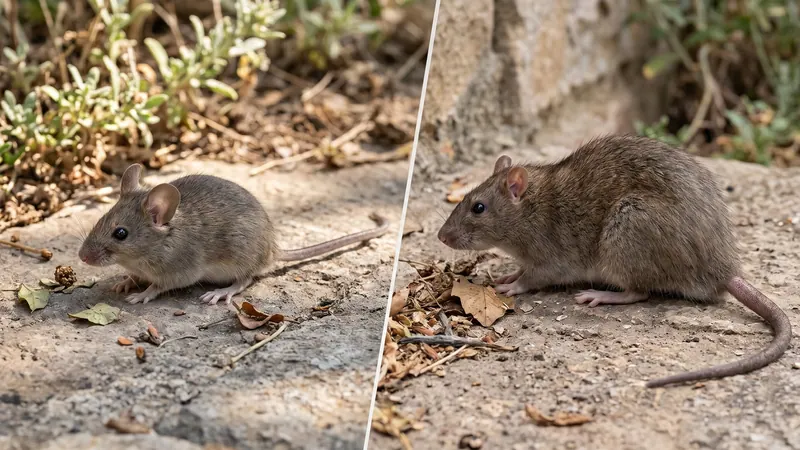
A gnawed packet in the larder, scratching in the loft, a hole dug beside the patio: all of these say “rodent”, but they do not say which one. The distinction matters, because rats and mice enter in different ways, live in different places and need different handling. This guide shows you how to build an answer from measurements and observations.
Start with size and shape
An adult house mouse weighs about half an ounce (roughly 14 g) and measures 5 to 7 inches (13 to 18 cm) including a 3 to 4 inch (8 to 10 cm) tail, according to the University of California’s house mouse page. Its tail is almost hairless.
Rats are far heavier. The Californian rat guide gives roof rats as 5 to 10 ounces (about 140 to 280 g) and Norway, or brown, rats as 7 to 18 ounces (about 200 to 510 g). Once you see one in the open, the difference is obvious.
Tail, nose and ears
If you get a good look, or a photograph, these features help to separate the two kinds of rat:
- Roof rat: pointed muzzle; ears long enough to reach the eyes when folded forward; tail that reaches at least to the snout when pulled over the back.
- Norway rat: blunt muzzle; ears that do not reach the eyes; tail that reaches only the middle of the skull.
- Mouse: small body, relatively large ears and small dark eyes.
Teeth marks you can measure
The same page gives rat tooth marks as about 1/6 inch (4 mm) wide, against about 1/12 inch (2 mm) for a mouse. Hold a ruler beside a gnawed corner and photograph it. Mouse marks look like many fine scratches, while rat marks are broader and deeper.
The location tells a story
| House mouse | Roof rat | Norway rat | |
|---|---|---|---|
| Nesting | Sheltered spots, built from shredded paper or fibre; behind boxes, in drawers or garages | Mainly above ground in shrubs, trees, attics and wall voids | Burrows near foundations, under rubbish and woodpiles |
| Range | Seldom more than about 9 m from nest and food | Travels along wires, branches and fences | Along the ground, often near drains and bins |
| Entry | Gaps about 6 mm high | Openings over 6 mm | Openings over 6 mm |
Mice, the page says, seldom venture more than 30 feet (about 9 m) from their nest sites and food supply. That makes the evidence local: droppings in one cupboard, nesting material behind the stored boxes. A hole dug beside the wall or beneath the bin points to a Norway rat. Noises overhead and tracks on beams suggest a roof rat.
How small is a gap?
The Californian pages say mice can squeeze under gaps a quarter of an inch tall and through openings three-eighths of an inch wide, while rat-proofing means sealing openings larger than a quarter of an inch. Young rats can squeeze under a door with a gap of only about half an inch. In plain language, if you can push a pencil into a gap, a mouse can probably follow it. Look at door thresholds, pipe entries, vents and cable holes.
Droppings: a rough guide
Mouse droppings are small, like dark grains of rice, while rat droppings are noticeably larger and thicker. They are only a rough indication, since size varies with age and diet. Fresh ones are dark and moist; old ones are dry and grey. When you clean up, avoid raising dust: use a damp cloth, gloves and a mask, bag the waste and wash your hands.
Both at once?
It is not unusual for a building to have both. Rats may hold the yard, the drains and the lower floor, while mice live in the kitchen. If you see droppings and gnaw marks of different sizes in different places, do not assume a single species.
What the species means for prevention
Once you know who is visiting, the outdoor jobs become clearer.
- Mice need the smallest gaps closed and food in lidded containers, with crumbs cleared from the kitchen each evening.
- Roof rats climb, so cut back branches that touch the roof, look at cables and fence tops used as bridges, and check the eaves and roof edge.
- Norway rats dig, so look at the ground level: foundations, the area under bins and woodpiles, and cracked drains.
The measures overlap, but starting with the right one saves effort.
Measuring beats guessing
People often describe a rodent as “huge” after a brief glimpse in torchlight, and a startled mouse can look twice its real size. Stick to numbers wherever you can. A ruler in the photograph, a measured gnaw mark and a gap you have checked with a pencil are all far more reliable than memory. Write the figures next to the date, so you can compare them with what you find a week later.
Why the trap must fit the animal
The Californian rat page advises rat-sized snap traps but also warns that mice and small juvenile rats often will not set them off, so you should confirm whether you have a rat or a mouse problem. A wrong guess leaves you with a trap that never fires and a rodent that carries on. That is the practical reason for taking measurements first.
Is it really a rodent?
Night noises overhead do not always come from rodents. Birds, squirrels, bats or the building expanding and contracting can also make sounds. Look for physical evidence: droppings, gnaw marks, greasy rub marks along walls and nesting material. Our winter mouse guide sets out the signs by month.
Keep a diary
For a week, record where you find signs, when you hear noises, how big the marks are and what the new droppings look like. A sprinkling of flour near a suspected entrance can show which way the tracks go. Put a ruler beside things when you take photographs. This turns a vague worry into evidence and shows whether your measures are working.
Kitchen and boat
In kitchens, rodent trouble generally starts with open food, rubbish and gaps behind appliances. The evening routine in our kitchen prevention guide is a good defence. Boats offer different routes, which our boat end-of-season check covers.
Sorting your findings
- Measure and photograph the animal, if you see it, and the droppings.
- Measure the teeth marks beside a ruler.
- Look for entry points: small for mice, bigger for rats.
- Find the nest or the line of travel.
- Put the evidence together and decide which animal it is.
If you remain unsure after that, a clear photograph with a ruler beside it is the most useful thing to show anyone who knows rodents.
Evidence in daylight, signs in several rooms or burrows around the foundations suggest the problem is bigger than one spot. Our rat page and mouse page describe the services we offer for each.