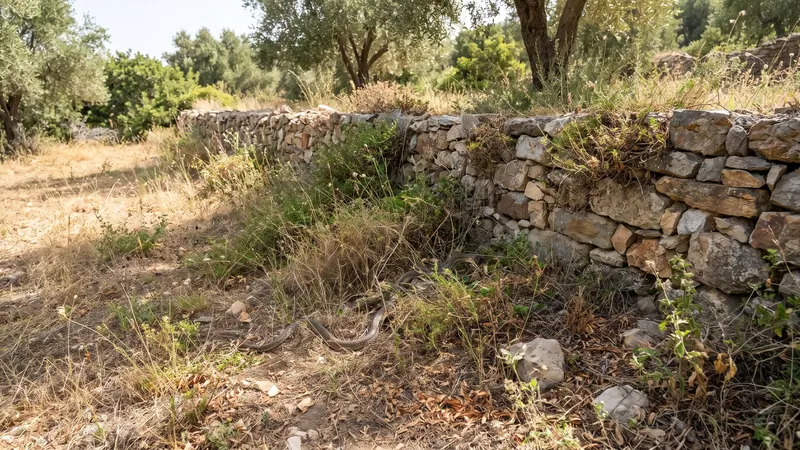
Rounding the woodpile with a watering can and spotting a long body on the path is a jolt. The instinct is to fetch a spade or to run. Both can go wrong. Snakes mostly want to avoid people, and bites tend to occur when one is cornered, handled or trodden on. The principle for the whole article is short: keep your distance, stay calm and leave the snake alone.
The first moments
- Stop where you are and avoid sudden movements.
- Back away slowly, a few steps, still facing the animal.
- Call children and pets in at once and keep dogs on a short lead or indoors.
- Do not throw anything, poke it or try to catch it.
- If it is safe, watch from a distance where it goes and remember the spot.
Dogs deserve a special mention, as their curiosity puts them within reach.
Venomous or not?
Most people try to judge by looks. Unfortunately head shape, markings and colour are unreliable at a distance, individuals vary and young snakes can differ from adults. Around the Mediterranean, venomous and harmless species both occur, so the safest rule is to treat every snake with caution. A photograph from a distance can help an expert identify it later, but never approach for a better shot.
If someone is bitten
Getting to medical care quickly is the priority. Keep the person calm, avoid alarming them further and call the emergency number (112 in Turkey) or go to the nearest health facility. The World Health Organization’s snakebite fact sheet describes antivenom as a highly effective treatment, notes that many victims never reach primary care facilities and that many opt for traditional practices rather than hospital care, and adds that children can feel the effects more quickly than adults because of their smaller body mass.
We deliberately give no first-aid detail here. The correct steps depend on the situation, so the emergency service and the doctor should lead. A photograph taken safely from a distance may help staff, but do not go near the snake for one.
What brings snakes into a garden
Three things draw them: shelter, shade or warmth, and food. Look at your plot with those in mind.
| Attraction | Why | What helps |
|---|---|---|
| Piles of wood, stones, rubble | Shade and hiding places | Keep them away from walls and raised off the ground |
| Long, dense vegetation | Cover | Mow regularly, particularly near paths and seating |
| Rodents | Prey | Remove food sources and deal with mice and rats |
| Leaking taps, pool edges | Water and cool | Fix leaks and keep the surroundings open |
| Old tarpaulins, plastic sheets | Sun-warmed shelter | Clear away unused material |
The rodent link matters. If your garden attracts mice or rats, it can attract their predators too, and our piece on the differences between rats and mice helps you work out which you have.
Is it a snake at all?
Not every long, legless creature is a snake. Some lizards have lost their legs. They have eyelids and visible ear openings, whereas snakes have fixed, unblinking eyes and no external ears. Garden hoses cause plenty of false alarms too. Still, checking at close range is a bad idea, so if you cannot tell from a distance, act as though it is a snake.
A papery, transparent skin lying in the grass is a shed skin. Snakes shed it as they grow. It shows that a snake has been around at some point, not that it is there now. Tidy the area and keep watching.
When snakes are most active
Snakes depend on external warmth, so they are more active as the weather warms. In a mild climate such as Bodrum’s, spring and summer bring the most sightings, with a pause in the hottest part of the day when they retreat to shade. Early morning and late afternoon are the times to take extra care around stone walls and the edges of long grass. In autumn they may seek warm, sheltered spots such as the sunny side of a wall or a woodpile. A torch on evening walks reveals what is underfoot.
Tackle clearing and trimming early in spring, before the season gets going, and wear sturdy closed shoes in rough areas.
A snake in the house
If a snake enters, close the door of the room it is in, open an outside door if you can do so without approaching, and keep everyone away. Do not trap it under a box or corner it. If you can see where it goes, note the place and take a photo from far away. Move children and pets out first.
Repeated sightings point to something drawing them in, such as mice in the walls. Droppings, scratching noises and gnaw marks in the house are worth chasing; the checklist in our winter mice guide is a good start.
Moving around the garden
Paths, dry-stone walls, steps and the covers of irrigation valves are places where snakes rest or hunt. Look before stepping, and use gloves when you lift stones or take wood from a pile. Never put your hand where you cannot see. Damp, shady edges of pools and irrigation lines attract frogs and rodents, and so snakes. Fix any trouble spots near the places where children play first.
Preparing the garden
The jobs are easy and inexpensive:
- Keep grass short along paths and around seating.
- Store wood, stones and building waste away from walls and off the ground.
- Prune low branches and shrubs from the base, so the view is open.
- Remove unused pots, sheets and tarpaulins.
- Do not leave pet food or birdseed out, as these draw rodents.
- Wear closed, sturdy shoes outdoors.
Before the summer season starts, our opening checklist gives a broader walk-round of a holiday home.
Letting it get in?
Snakes seldom come inside on purpose, but gaps beneath doors, basement openings, pipe gaps, wall cracks and uncovered vents make it easy. Close the gaps, protect vents with fine mesh and keep basement and garage doors shut at night. These steps also keep out mice and insects.
Afterwards
When the snake has gone, don’t forget about it. Write down where and when you saw it, then look for rodent signs or hiding places. If it returns, don’t approach; send a photograph and location to someone who knows. Killing a snake or interfering with its refuge puts you in danger, and wildlife rules may apply.
Three sentences for children
“I don’t touch it. I tell a grown-up straight away. I walk away slowly.” An open lawn with short grass also gives children less reason to put hands under stones and wood.
In an emergency such as a bite, call the emergency number or go straight to a health facility. For recurring sightings in a large garden, our snake page describes the service we offer.