
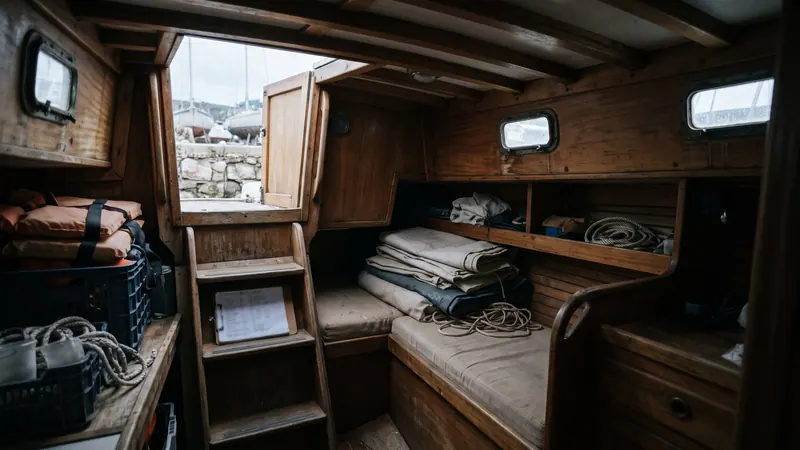
At the end of the season a skipper has plenty on the list: engine, hull, rigging, sails. Pests rarely feature until the day in spring when the cabin door sticks and there is a smell. Crumbs, damp bedding and an unreachable locker are all that rodents and insects need. The checklist below is arranged by position on the boat, so that you can work along it in a single day without missing a section.
Why a boat is a special case
Space is tight and every gap is a hiding place. Panels, lockers and the bilge are not easy to reach. The boat is joined to the shore by lines, cables and a gangway, which may serve as bridges. The air is damp, which suits mould and moisture-loving insects. And since a boat can stand unvisited for months, a minor problem has time to grow. The principles in our closing-up checklist for houses apply here too: take away food, reduce damp, close entry points and plan a check.
Forepeak and cabins
- Stand mattresses and cushions on edge so air reaches both sides, and dry them ashore if you can.
- Wash bedding and leave it fully dry before storing it in closed bags.
- Leave locker doors open to let air move.
- Look under the berths for stains, odours or insects.
- Store clothes clean and dry, in sealed bags.
Wool and fur items may be eaten by moth larvae, as our article on clothes moths and pantry moths explains.
Saloon and galley
The galley is the highest-risk area, since food is stored and prepared there.
- Take off all open dry food: flour, pasta, pulses, nuts, biscuits, tea, coffee and spices.
- Empty the lockers and fridge, wipe them, and sweep or vacuum crumbs.
- Leave the fridge door ajar to avoid odour and mould.
- Empty, wash and dry the rubbish bin, and leave it open.
- Clean around the sink and drain.
- Consider taking tins ashore as well; long-lasting food still feeds a determined rodent.
Engine bay, bilge and storage
These are out of sight, so problems stay hidden.
- Look in the bilge for water, oil or rotting organic matter.
- Examine cable and hose passages for gnawing.
- Keep spares, paint and oil in lidded, sealed containers.
- Remove cardboard and newspaper, which give damp, warmth and nesting material.
- Take out piles of rags and old carpet.
Cockpit lockers, deck and mooring
The CDC page on sealing up to prevent rodents says mice can fit through a hole the width of a pencil, about 6 mm. It recommends filling small holes with steel wool held in place with sealant, and using metal or hardware cloth for larger ones. On land it also advises storing rubbish and animal feed in tightly lidded containers. Applied to a boat, that means:
- Check where lines, shore power cables and hoses cross the gap to the quay.
- Close vents, grilles and cable entries with durable material, but keep ventilation working.
- Take away loose items from the deck and shut lockers.
- Check the dinghy and its cover and storage bag too.
The University of California notes that roof rats mainly nest above ground, in shrubs, trees, dense vegetation and attics. They climb well, which is a reminder that a line or cable can serve as a ramp. Our rat or mouse guide helps you read what you find.
Where the boat sits matters
A boat tied up stern-to beside a quay with restaurants, bins and market stalls close behind it may see more animal traffic across its lines than one on a swinging mooring or a quiet pontoon. If yours is the first kind, pay more attention to the lines and shore connections, and be stricter about food on board. If the boat is ashore in a yard, look for gaps around the cradle and ladder, and check that cover sheets do not trap damp underneath. A walk along the quay or through the yard shows what is nearby and which routes are likely.
Damp and air
Moisture is the most overlooked part of laying up. A shut boat quickly gets mould and a musty smell, and attracts silverfish and other damp lovers. Leave vents open where rodents cannot enter, and dry lifejackets, towels and cushions ashore. If you use a moisture absorber, check and empty it often. The thinking is the same as in our piece on silverfish in the bathroom.
Plan the day
A rushed lay-up leads to mistakes. Start a week ahead by using up perishable food. Spend the last three days cleaning section by section. On the last day just check. Give each person on board a section, so nobody assumes “someone else did it”. Photograph the galley, cabins, bilge and deck once you have finished; in spring those photographs show immediately whether anything has changed.
Typical mistakes
- Leaving tins, biscuits or spices on board because they are long-life.
- Closing the fridge tightly, which breeds mould and smell.
- Storing damp cushions and bedding.
- Forgetting cardboard, paper and plastic bags in lockers.
- Treating lines and cables as part of the boat and not as a route.
- Not visiting once during the winter.
- Cleaning only what is visible and skipping behind cupboards and under the sole.
Easy rules for the season
Prevention is easier if the crew follows simple rules: eat in the cockpit or galley, keep food out of cabins, take rubbish ashore each day in tied bags, and leave nothing edible on board at the end of a trip. Guests find the rules reasonable if they hear them at the start.
Final checklist
| Area | Done when |
|---|---|
| Galley | Food off, lockers wiped, fridge open |
| Cabins | Bedding dry, cushions aired, lockers open |
| Bilge | Checked for water, oil and gnawing |
| Deck | Lines, cables and vents checked |
| Rubbish | Emptied, bin washed |
| Record | Date and photographs taken |
During the winter
Visit within the first week and then about once a month. Smell, look for droppings and gnawing, and check for damp. Date your notes and photographs. When you open the boat in spring, do not sweep droppings dry: use a damp cloth, gloves and a mask, then wash your hands. For problems that are beyond a quick fix, see our page on yacht and boat pest control; our winter mouse guide is also relevant for boats berthed near land.