
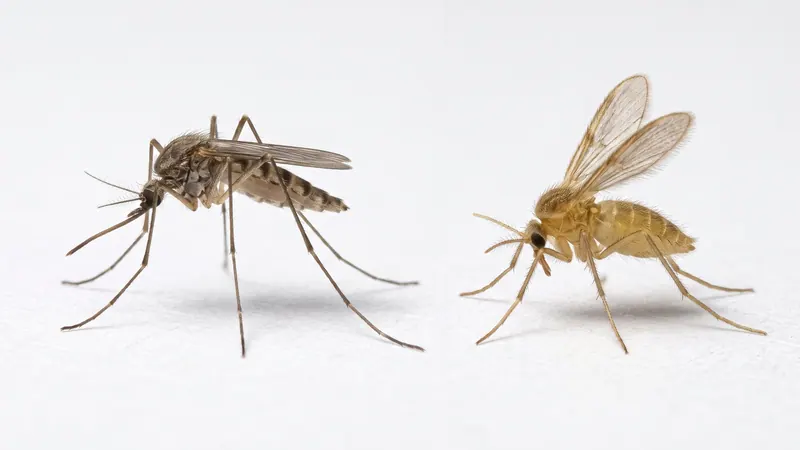
Sitting on a balcony on a summer evening or sleeping with the window open, you assume that a mosquito bit you. Often you are right. In warm places near the sea, a sandfly can be involved as well. The two insects have different biology, so the sensible precautions are different too, and a wrong guess means effort spent in the wrong place.
The limits of looking at the bite
Let us be honest first: the bite itself is not enough evidence. Both insects take blood and both leave an itchy swelling. So base your judgement on several observations, not one: what time you were bitten, whether you saw the insect, whether you heard it, and where you were sitting. The comparison below pulls those observations together.
| Observation | Mosquito | Sandfly |
|---|---|---|
| Size | Noticeably larger, long legs | Tiny, hard to see |
| Sound | High-pitched whine | Almost silent |
| Body | Slender | Hairy, hunched look |
| Wings at rest | Flat along the body | Held upright in a V |
| Breeding site | Still water | Damp soil with organic matter, cracks |
These are general features, and you may not be able to separate individuals at a glance.
Size and flight
A mosquito is slim with long legs and is easy to see, often drifting towards a light or settling on a wall. A sandfly is so small that in the air it may look like a speck of dust, and its flight is quiet. Most people notice a sandfly after it has bitten rather than before.
That gives a practical clue. If you hear a whine beside your ear, it is probably a mosquito. If you are bitten without hearing anything, a sandfly becomes more likely. Gather more evidence before you decide.
Timing and place
Mosquitoes are most active in the evening and at night and gather near still water. In Bodrum the first places to check are the pool edge, plant saucers and blocked gutters. Sandflies are generally active at dusk and during the night, and they favour places such as stone wall crevices, voids under floors and damp garden margins. By day they rest.
Ask where the bites happened. If you were outside, particularly near a stone wall or an animal shelter, a sandfly is a stronger possibility. If you were in a bedroom with a whine beside your ear, a mosquito is more likely.
Why it matters
Sandfly bites need a little more care in some parts of the world. The WHO’s leishmaniasis fact sheet says the disease is caused by parasites transmitted by the bite of infected female phlebotomine sandflies, and that the females feed on blood in order to produce eggs. It also notes that poor housing and sanitation may increase sandfly breeding and resting sites, and that sleeping outside or on the ground may increase risk.
There is no need for alarm. The information simply shows why a bite sore that does not heal over several weeks deserves a visit to a health professional. Diagnosis is not our job, but it helps to be able to tell the doctor the date, the place and the number of bites.
Precautions differ
With mosquitoes the main principle is to remove still water: empty plant saucers, keep gutters and drains clear and turn over unused containers. The WHO’s vector-borne diseases fact sheet lists window and door screens and air conditioning as ways of reducing contact between mosquitoes and household members.
With sandflies the emphasis shifts:
- Make cracks in garden walls and foundations tight.
- Keep piles of leaves and other organic waste away from the house.
- Clear damp, shaded corners of the garden regularly.
- Place outdoor seating well away from stone walls and shrub margins where you can.
These measures complement each other. Tidying the pool edge and ignoring a cracked stone wall will not solve a sandfly problem. If you shut a house for winter, our holiday home closing checklist includes switching off irrigation, clearing gutters and fixing leaks, which also take away breeding sites.
After a bite: simple care
Itching usually fades within a few days. Wash the area with clean water, try not to scratch and keep nails short. Children scratch more, so if there are many bites or redness is spreading, ask a health facility. If symptoms persist or are severe, seek care. This page is not medical advice, only an explanation of which observations are useful.
Screens and doors
The most common mistake with sandflies is trusting the screen alone. A standard mosquito screen may stop mosquitoes without stopping a much smaller insect, particularly where the frame leaves a gap. Before you open a window in the evening, ask:
- Is there a stone wall, shrub or animal shelter just outside?
- Is a light shining out towards the window? Outdoor light draws insects to it.
- Does the screen fit the frame snugly, with no gaps at the corners?
- Do you need the window open all night?
Moving lights away from the window and switching off a bedside lamp reduces the pull. A small fan also helps, because tiny flying insects struggle in moving air.
Why the breeding site is harder to find
A mosquito’s breeding site is easy to find: any container with wriggling larvae will do. Sandfly eggs and larvae develop in damp soil, in cracks and among organic debris, so you cannot simply look and see. That difference explains why the same method does not work for both.
When you look for the source, check:
- leaf litter and rotting plant material at the foot of garden walls,
- joints in stone walls and dry-stone terraces,
- feed and droppings near an animal shelter,
- leaking drains and septic tanks,
- strips of soil that an irrigation hose keeps wet.
Removing the source works far better than chasing single insects. In a large garden or an old stone house, though, finding every spot alone can be difficult.
Three evenings
Evening one. At eight, you are sitting in a garden with stone walls and get small bumps around the ankles, but you heard nothing. The timing, the silence and the stone walls all point towards a sandfly.
Evening two. At night in the bedroom you hear a whine near your ear and wake with bites on your face and arms. The sound and the indoor setting suggest a mosquito, so look at the window and at any water containers.
Evening three. You wake with bites in a neat row on the parts of the body covered by the sheet. Neither insect should be your first suspect. Look at the bed instead, and read our guide to bed bugs and luggage after travel for how to check.
These examples do not diagnose anything. They show how to line up the clues. Each time, think about the time, the place and the sound together.
Keep a two-week diary
The most useful way to find the culprit is a short diary. For each bite note:
- date and time,
- what you were doing and where you sat,
- whether you heard or saw anything,
- whether windows and doors were open,
- which part of the body was bitten.
After two weeks a pattern shows. Bites that always come outside in the evening on ankles and arms point to the ground and walls nearby. Bites that always come at night in the bedroom, round the face, point to something that has got indoors.
After you have taken steps
If the number of bites does not fall once you have fixed the obvious things, the source is probably a breeding area nearby, and finding it will do more than swatting individuals. You can read about how we handle these insects on our page on mosquito and sandfly control.