
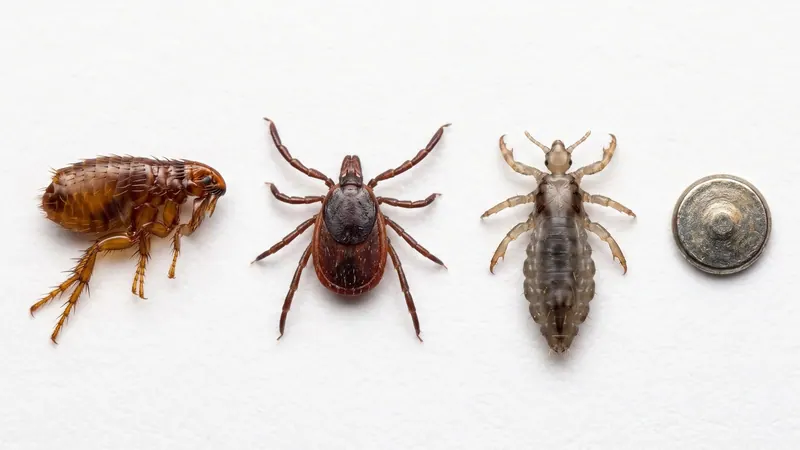
You wake up with a cluster of itchy red dots around your ankles. Or you notice a small dark lump behind your knee after a walk. Or your child comes home from school scratching their head. All three situations involve a blood-feeding or skin-irritating parasite, yet the sensible response differs completely: a flea problem lives in carpets and bedding, a tick belongs to the countryside, and lice belong to people and their close contacts. Before you reach for any product, work out which of the three you are dealing with.
Three animals, three different homes
Fleas and lice are insects with six legs. Ticks are relatives of spiders, and the adults have eight. You will rarely be able to count legs, so the habitat tells you more. Fleas thrive wherever a pet sleeps, in rugs, sofas and floor cracks. Ticks wait on tall grass and scrub for a passing animal or person. Lice stay on the head and travel only when two heads touch or when personal items are shared.
The flea: small, springy and hard to catch
The University of California’s flea guide describes adults as no more than about 3 mm long (one eighth of an inch), reddish-brown, wingless and flattened from side to side, so they look as if they are walking on edge. If you try to pinch one it will usually vanish with a jump.
What matters at home is the life cycle. The same guide explains that eggs fall off the pet into bedding and carpet, larvae feed on dried blood and adult flea droppings in sheltered spots, and the whole cycle takes around 18 days at room temperature. Pupae sit in silken cocoons, and at cool temperatures the adults can wait inside for up to twelve months. Warmth and pressure, from walking across or vacuuming a carpet, prompt them to emerge. That is why a quiet holiday flat can suddenly seem alive with fleas on the day you arrive.
Typical flea bites are small, itchy and grouped, mostly around ankles and lower legs.
The tick: patient, and usually met outdoors
A tick does not jump or fly. It climbs onto a grass stem or a bush, waits and grabs hold of whatever brushes past. Unfed ticks can be only a few millimetres across, while a feeding one swells to the size of a bean. Because the bite is usually painless, people often find the tick rather than the bite.
Favourite attachment spots are warm and hidden: behind the ears, in the scalp, armpits, behind the knees and in the groin. Pets are checked around the ears, neck, armpits, between the legs and under the tail. Do the check as soon as you come in from scrubland or a picnic, and put the clothes straight into the wash.
If you do find one attached, the US Centers for Disease Control and Prevention give a clear method on their page about what to do after a tick bite: use clean fine-tipped tweezers, grip the tick as close to the skin as possible and pull it away with steady, even pressure, without twisting or jerking. Do not use petroleum jelly, heat, nail polish or other substances to make it let go, and do not crush it with your fingers. Clean the area and your hands afterwards. The page adds that anyone who develops a rash or fever within several weeks should see a doctor.
The louse: a passenger that stays on the person
Head lice are small, greyish-brown and a little larger than a sesame seed, with a flattened body. They crawl rather than jump and glue their eggs, called nits, to the hair close to the scalp. The first sign is almost always an itchy scalp, and what people spot are usually the nits, not the lice.
A louse is a personal parasite, not a household one, so spraying a room achieves nothing. The right first call is a pharmacist or doctor, which is why lice get no further detail in an article about pests in the building.
Side by side
| Flea | Tick | Louse | |
|---|---|---|---|
| Legs (adult) | 6 | 8 | 6 |
| Jumps? | Yes | No | No |
| Usual home | Carpets, pet bedding, floor cracks | Tall grass, scrub, woodland edges | Human hair |
| Typical bite sites | Ankles and lower legs | Warm, hidden folds of skin | Scalp, neck |
| Where the fix lies | Pet and home cleaning | Outdoor habits, body checks | Personal treatment |
Why the mark itself proves little
Skin reactions vary wildly. Two people sleeping in one room may show completely different marks from the same insect. Mosquitoes, sandflies and bed bugs can all produce similar spots, which is why we stress the surrounding facts. For a traveller, a bite that appears after a trip makes our luggage check after travel more relevant than a flea hunt.
Ask four questions instead of studying the bite:
- When? At night, in the morning, or after time outdoors?
- Where on the body? Ankles only, or warm folds, or the scalp?
- Which surroundings? Pets, rugs, a garden, a recent trip?
- What evidence? A captured animal, a photograph, droppings on a pet’s coat?
The white sock and the saucer
To check for fleas without any equipment, walk slowly around the room in clean white socks pulled up over your trousers. Dark specks that hop onto the fabric point to fleas. A pale dish of soapy water beside the bed overnight under a lamp can also trap a few. Neither method is proof, but both turn a suspicion into something you can act on.
Pet owners sometimes find small black grains in the coat. Put them on damp white kitchen paper: flea droppings leave a reddish-brown smear because they contain dried blood, whereas ordinary dirt does not.
If the problem is fleas
Concentrate on the places where eggs and larvae develop, not on the adults you can see. The Californian guide recommends washing pet bedding in hot soapy water at least once a week, vacuuming carpets, rugs, upholstery and crevices often, and sealing and discarding the vacuum bag or its contents so nothing escapes. Treating the animal itself is a matter for the vet, because suitable products depend on species, weight and age. Never assume a product made for people, or for a different animal, is suitable.
For houses that have stood empty, the routine in our guide to opening a holiday villa covers the first-day checks, and our flea page explains what we do when home cleaning has not been enough.
Garden notes
Long grass, leaf piles and the edges of shrubs suit ticks, so keeping the lawn short and clearing debris near seating areas lowers the chance of a meeting. Wild animals that shelter under terraces can bring fleas as well. Remove food and water you may have left out for them, and block gaps under decking.
Keep a two-week diary
If bites keep returning, write down dates, body areas, places visited and whether pets or children were involved. Two weeks of notes usually reveal a pattern: if marks always follow a particular room, look there; if they follow every walk, think of ticks. The diary is also useful for the doctor or vet, who will ask the same questions.
A product only works against the animal it was made for, so identify first and treat second. Misdirected sprays waste money and add chemicals to a home for no reason.