
There are two mistakes in dealing with pests: calling too early and calling too late. The first costs money for something a tidy kitchen would have fixed. The second lets a small, cheap problem become a large one. The questions below will not give you a formula, but they will help you decide in a calmer way.
Five questions to put to yourself
- How long has it been going on? A few days, or several months?
- How widespread is it? One corner, or more than one room?
- How many? A lone animal, or lines and groups?
- What have you done already, and what happened? Cleaning, traps, products, and the outcome.
- Who is affected? Babies, pregnant women, older people, pets, guests or customers?
Written down, those five answers show the scale quickly.
Situations that can wait
- A short line of ants in one spot, in the right season.
- A single fly or mosquito at the window.
- A harmless web-building spider in the corner of the garden.
- A few fruit flies that came in on a bag of fruit.
In cases like these, tidying the kitchen, handling waste properly, closing entry points and controlling damp are normally enough. The US Environmental Protection Agency’s guide to smart pest control puts it simply: pests such as cockroaches, rodents and mosquitoes need food, water and shelter, so sealing food, removing rubbish regularly and not leaving pet food and water out overnight comes first. Our kitchen routine turns that into daily habits.
Signs that home measures are not enough
It keeps coming back. If cleaning only buys a pause, the source has not been found.
It is spreading. Moving from one room to another, or appearing in neighbouring flats, makes piecemeal action inefficient.
You see it by day. Cockroaches, for example, are almost entirely nocturnal, so seeing them in daylight is unusual and worth taking seriously.
There is damage. Holes in timber, gnawed cables or ruined rugs can become expensive.
There is a health worry. Bites, allergies or possible contamination of food matter more where children or ill people live.
You cannot find the source. Scratching noises inside a wall or ceiling void are a place you cannot reach with a torch.
You run a business. For a guesthouse or café, one complaint can damage a reputation. The guesthouse checklist shows what a regular routine looks like.
A quick guide by pest
| Situation | Try first | Think about an inspection when |
|---|---|---|
| Ants | Seal entry, clear food | The trail returns every year, or sawdust-like debris appears |
| Cockroaches | Night checks, traps, cleaning | You see them by day, or find egg cases |
| Mice or rats | Seal gaps, store food away | Noises in walls, droppings in several places |
| Fleas | Treat pet, wash and vacuum | Bites continue and the source is unclear |
| Marks around a bed | Photograph and examine closely | Straight away, to confirm what it is |
| Wasp or bee nest | Watch from afar, keep clear | The nest is near a door or a path |
| Moths | Clean storage, vacuum | Rugs or furniture are damaged |
What to do before anyone visits
A little preparation saves time and gives a more accurate assessment:
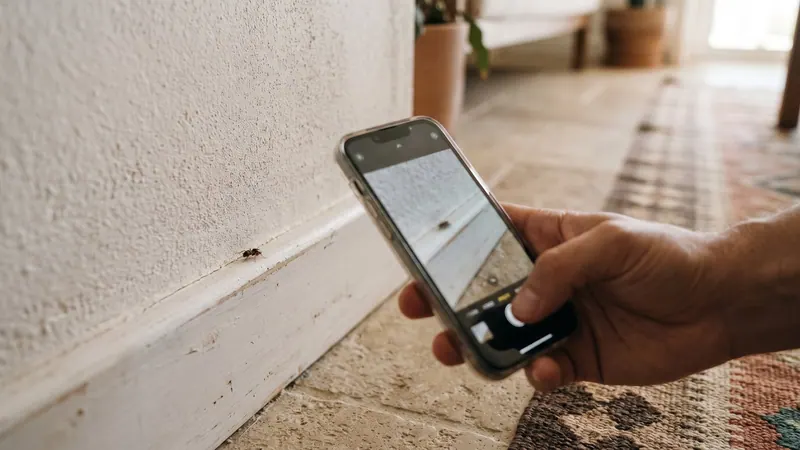
- Take photographs of the insect or droppings, the damage and possible entry points.
- Keep a specimen in a jar if you can.
- Write notes: date, place, time, number and what you tried.
- Clear food away, especially in the kitchen and pantry.
- Give access to cupboards, the area around the bed and cellars or stores.
If you are unsure which cockroach or ant you have, our guides to cockroach species and ants in the house may help you describe it accurately.
The “wait a week” rule
Delay usually works against you with fast breeders such as cockroaches and mice, as a fortnight can multiply a population. Yet reacting to every sighting is unnecessary too. A good compromise is a rule you set in advance: “I will clean, seal and monitor for one week. If the signs are not falling, or are spreading, I will ask for help.” It stops both panic and neglect.
Blocks of flats and shared buildings
In an apartment block, shared bins, cellars, gardens and pipe shafts can feed several homes at once. Treating one flat alone is therefore of limited use. Talking to neighbours and asking the building manager to look at common areas speeds up finding the cause. Our article on pest complaints in residential complexes covers how to record and handle that.
If you decide to try things yourself
- Read and follow the product label, and never mix products.
- Keep everything out of reach of children and pets.
- Avoid strong-smelling products in closed rooms without ventilation.
- If something has not worked, ask why before using more of it.
- Write down what you used, where and when.
Safety depends on the product, how it is used and who is in the home, so check the label and ask a professional when in doubt.
Questions worth asking any company
- How will you work out which pest is causing the problem?
- What should I do before and after a visit if children, pregnant women, older people or pets live here?
- Which areas will be treated, and which will be left out?
- If the problem returns, who do I contact and how?
- What can I do on my side about food, damp and entry points?
Keep the answers in writing, particularly if you are comparing more than one company. A clear explanation of the method is a better sign than a promise that one visit settles everything.
Seasons change the answer
In summer, ants, flies, mosquitoes and wasps multiply quickly, and waiting makes the situation worse. In winter, rodents and shelter-seeking insects are the issue. For the cold months, our guide to mice in winter sets out what to check month by month.
Keep a short log
Spend three or four days noting what you saw, how many, at what time, what you did and what happened. If the numbers fall, your measures are working; if they stay level or rise, you are probably missing the source. The log gives an inspector the same information that you have.
Booking an inspection
Ask any firm to show its authorisations. Ours are listed on the certificates page. We carry out a free inspection first to identify the pest and the area involved, and only then do we propose a method. Send us your photographs and notes through the contact page and we will agree a time that suits you; the services page shows what else we cover.