
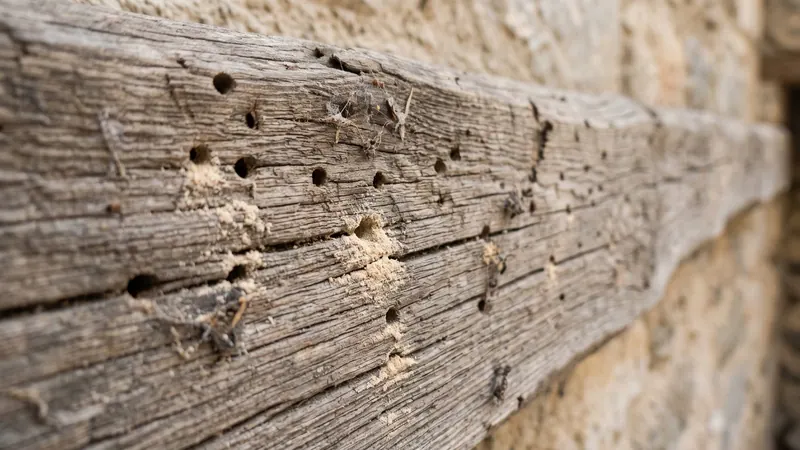
An old chest, a door frame or the beam under a roof can show tidy round holes the size of a pinhead. The first thought is woodworm, which in everyday speech means the larvae of several wood-boring beetles. The holes, however, mark the end of the story, since the beetle emerged from them. The larvae may have spent years inside before that. So the key question is not whether there are holes, but what those holes, the dust and the surrounding conditions say about the timber today.
Why it is hard to spot
The University of California’s guide to wood-boring beetles in homes says detection can be difficult, because much of the life cycle takes place beneath the wood surface. The same applies to the passage of time. Powderpost beetles take from about three months to over a year to develop, deathwatch beetles about two years per generation and most false powderpost species about a year. An infestation can therefore run quietly for a long time before anything shows.
Each of the signs below is only a partial clue. Taken together, they give a useful picture.
Clue one: the exit holes
When a mature beetle leaves the wood, it bites a round hole. According to the guide, powderpost beetle holes are tiny and round, false powderpost holes tend to be uniform in size, and deathwatch holes can be of various sizes.
When examining holes, ask:
- Are they scattered at random or grouped in one area?
- Are the edges crisp and clean, or worn, painted or polished over?
- Does the number of holes increase from one month to the next?
Sharp-edged holes suggest recent emergence, and holes sealed by varnish or paint suggest older ones. The guide does not say this, so treat it as a rough observation, not a rule.
Clue two: the dust
The waste that larvae push out of tunnels is called frass. Per the guide, powderpost frass is fine and powdery, like flour or talc. Deathwatch frass consists of very small pellets, grittier than powderpost frass. False powderpost frass is the coarsest and grittiest of the three and is hard to dislodge from exit holes.
A simple test: stick a sheet of clean paper or dark cloth beneath the holes and leave it for a few weeks. Fresh dust accumulating is a reason for concern. It is not a laboratory test, though, and old dust can also fall from a disturbed piece, so use it as one input among others.
Clue three: dead beetles at the window
Adult wood-boring beetles are drawn to light. The same guide says dead adults on windowsills may indicate beetles that tried to leave the wood. If you find several, especially when the number grows through spring and early summer, collect them in a jar. A close photograph helps too.
Clue four: the timber itself
A thinned section may feel soft, slump under pressure or make the floor spring. Listening for tapping at night is unreliable. If a beam, staircase or balcony support is involved, seek the view of a builder or structural engineer, because strength could be affected.
Damp: the underlying cause
The guide states that deathwatch beetles prefer wood above about 14 percent moisture, which is why they are more often found in damp crawl spaces, basements and outbuildings than in heated and cooled homes. Powderpost beetles, by contrast, can attack very dry wood, down to about 8 percent moisture. So damp is relevant to some beetles but not all, and tracing it is worthwhile in any case. The same logic as in our article on silverfish in the bathroom applies: find the source of the moisture first.
Which timber is at risk?
The guide notes that powderpost beetles favour hardwoods, whose pores suit egg-laying, while deathwatch beetles mostly attack softwoods, particularly in old or partly decayed wood. False powderpost beetles attack a range of hardwoods and sometimes softwoods. So an antique oak chest and a pine joist in a damp cellar may attract different beetles. If you do not know the timber, record the age of the piece, the room it is in and whether the surface is raw or finished.
It also notes that sealing wood with paint or varnish closes the pores and cracks where eggs are laid. Look behind and underneath furniture, on unfinished backs and under drawers, because holes in a polished front may be hidden.
Identify first, decide second
Many mistakes begin with hurried action. Before you rub anything into the wood, find out what you are dealing with: an active infestation, a long-finished problem or a different animal. The wrong diagnosis wastes time and can cost you a good piece of furniture. Good notes, photographs and a few beetles are valuable. We do not recommend products or methods here, since the choice depends on the species and the item.
Could it be something else?
Small holes in wood are not always woodworm.
- Ants. Carpenter ants excavate rather than eat wood, and their debris contains insect fragments. Our ant guide helps with identification.
- Termites. Their droppings are small pellets, a sign quite unlike fine dust.
- Old nail or screw holes. These are straight and tidy, often with metal staining.
- Mechanical marks. Tool marks or wear follow the grain and are irregular.
Keep a record card
For each suspect piece, write its name and place, number of holes, the colour and texture of any dust, the number of beetles found at the window and the date. Update it every two weeks. If the count stops rising and the paper stays clean, the damage may be historical. If the count rises, you have evidence to show.
What you can do meanwhile
- Photograph the area and note the date and number of holes.
- Put clean paper under the holes and wait two or three weeks.
- Move the item away from damp, and ventilate the room.
- Inspect nearby timber such as doors, frames and stairs.
- Keep a valuable antique apart from other furniture if you can.
None of this fixes the problem, but it gathers the information you need.
Shut-up houses and lofts
Holiday homes closed for long periods and roof spaces neglected during damp spells give beetles peace and quiet. Looking at the timber when you shut and reopen a property is therefore sensible, and the closing-up checklist covers part of it.
When to get an expert to look
New dust in several pieces of timber, a window sill full of dead beetles, soft or sagging wood, or a valuable item all justify an assessment on site. Our woodworm page outlines the service, and you can ask for a free inspection through the contact page.